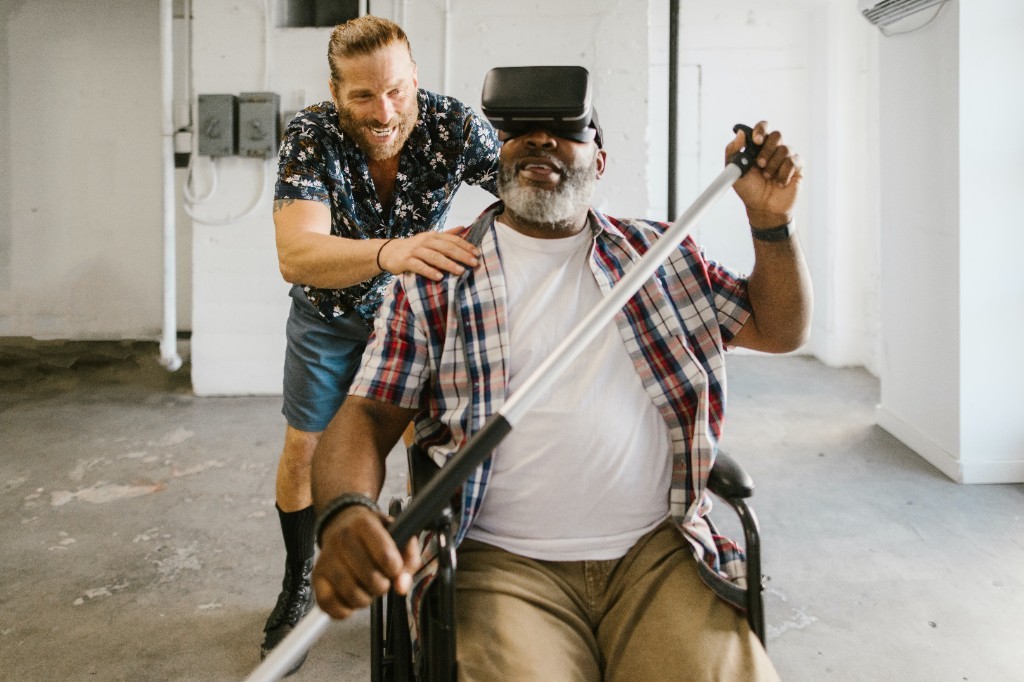

In recent years, there has been a significant advancement in the field of Artificial Intelligence (AI) and Augmented Reality (AR). These technologies have become increasingly popular and have the potential to enhance virtual experiences in various fields such as gaming, education, healthcare, and...
A Digital Engineer Calculates a Bridge's Structural Integrity from a Photograph
169
06.07.2026

Infrastructure maintenance is one of the most critical challenges facing modern society. Bridges, in particular, are the lifelines of commerce and daily life, yet they are subjected to relentless physical stress from traffic, weather, and the slow march of chemical degradation. Traditionally, inspecting these massive structures has been a time-consuming, expensive, and often hazardous task requiring specialized personnel to perform manual audits. However, the rise of digital engineering and computer vision is revolutionizing this sector, enabling a "digital engineer" to assess a bridge's structural integrity using nothing more than a high-resolution photograph.
This breakthrough is not based on guesswork. It is the result of applying deep learning and geometric photogrammetry to civil engineering, transforming a flat 2D image into a high-fidelity diagnostic report. By analyzing micro-fractures, structural deformations, and surface irregularities, AI can provide a level of oversight that was previously impossible to achieve at scale.
The Mechanics of Digital Inspection
A digital engineer—in this context, an AI-powered software platform—operates by performing a "semantic scan" of the structural image. The process is divided into several rigorous analytical phases.
1. Feature Extraction and Photogrammetry
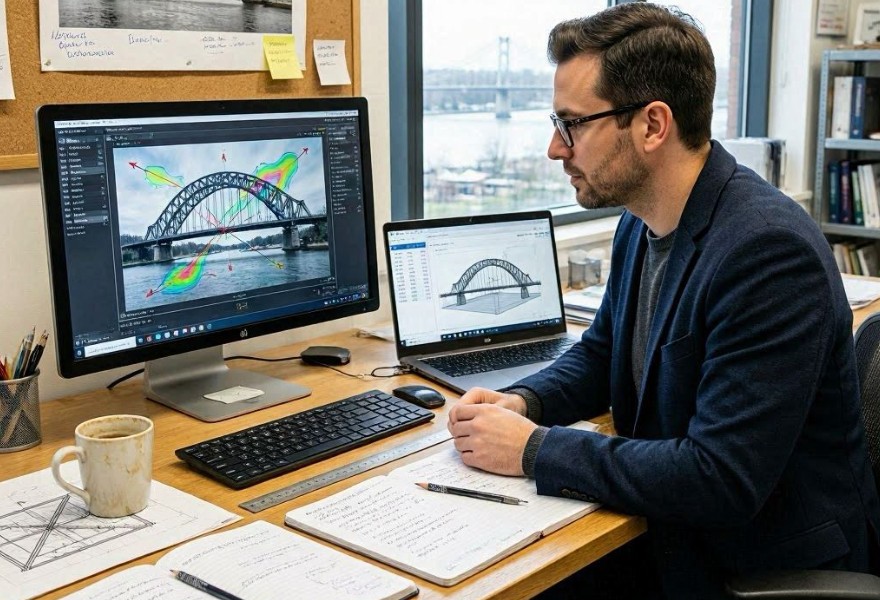
The system begins by mapping the geometry of the bridge from the photograph. Using advanced photogrammetry, the software triangulates the distance and orientation of structural members based on pixel-level data. It creates a digital "mesh" of the bridge, allowing it to detect even the slightest deviations in alignment. A sagging girder or a bowed support cable—visible to the AI before they are apparent to the naked eye—is flagged for immediate review.
2. Fracture and Corrosion Detection
Computer vision models, trained on millions of images of structural failures, are capable of identifying surface cracks and chemical staining. The AI looks for:
- Micro-cracks: Identifying fatigue-induced fissures in concrete or steel that are often obscured by dirt or shadows.
- Efflorescence and Rust: Detecting the characteristic stains that indicate water penetration or structural oxidation.
- Surface Anomalies: Locating areas where the structural coating has been compromised, signaling an entry point for environmental degradation.
Predictive Maintenance and Structural Modeling
Detection is only the first step. The true power of digital engineering lies in its ability to integrate this data into structural health monitoring (SHM) systems. Once the AI identifies a physical defect, it feeds this information into a finite element model (FEM).
Dynamic Load-Bearing Simulation
By inputting the dimensions of detected cracks and the overall geometry of the bridge into a simulation, the software models how the structural integrity is impacted under current traffic loads. It can predict:
- Stress Concentration: Determining if a crack in a primary support member is redirecting load in a way that risks cascading failure.
- Remaining Service Life: Providing an estimate of how many years a structure can remain safely in service given its current rate of degradation.
Efficiency at Scale
The economic and safety advantages of this approach are immense. Instead of relying on manual inspections that happen every few years, public works departments can now conduct continuous monitoring using images captured by drones, passing vehicles, or even stationary street-level cameras. This creates a "digital twin" of the infrastructure, allowing engineers to monitor the health of an entire city’s bridge network from a central office.
The Human-Digital Synergy
Despite the sophistication of these algorithms, the digital engineer is not a replacement for human judgment. Instead, it acts as a force multiplier for civil engineers. It filters out the thousands of "healthy" structural images, leaving human professionals to focus exclusively on those areas where the AI has flagged a potential risk. This approach ensures that limited maintenance budgets are directed exactly where they are needed most, rather than being squandered on blind, blanket inspections.
Conclusion: A Safer Future
The ability to calculate structural integrity from a photograph marks a major turning point in civil engineering. It shifts the paradigm of infrastructure maintenance from reactive, emergency-based repairs to proactive, data-driven prevention. By empowering engineers with AI-driven vision, we are moving toward a future where our bridges are safer, more resilient, and managed with the precision that our modern world demands. As the technology matures, it will undoubtedly save countless lives and billions of dollars in infrastructure costs.