
In recent years, there has been a significant advancement in the field of Artificial Intelligence (AI) and Augmented Reality (AR). These technologies have become increasingly popular and have the potential to enhance virtual experiences in various fields such as gaming, education, healthcare, and...
A Digital Historian Dates Old Objects from Photographs More Accurately Than Experts
204
27.05.2026
Why dating historical objects is a complex task
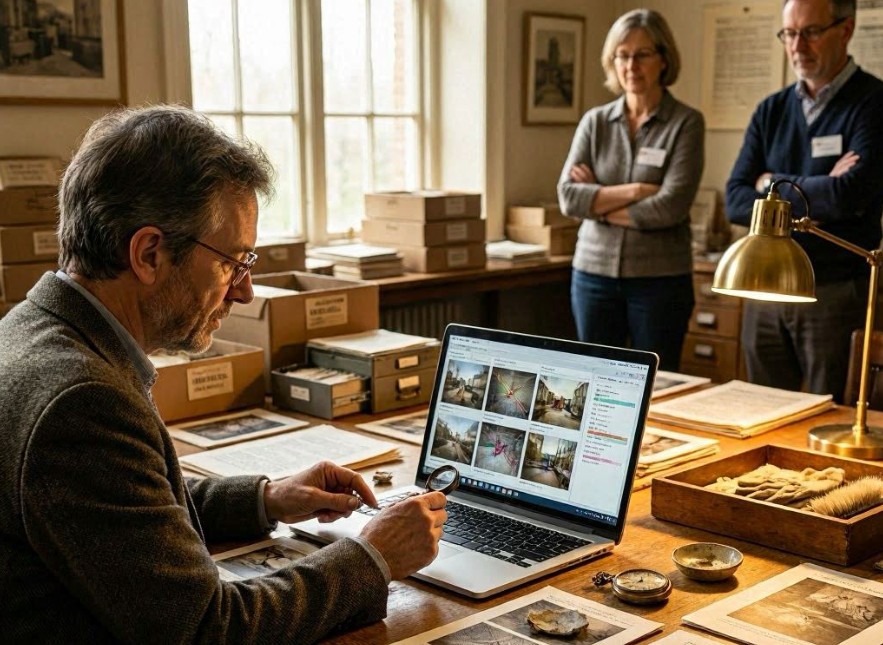
Determining the age of historical objects is a central challenge in archaeology and history. Traditionally, experts rely on material analysis, stylistic comparison, and contextual evidence from excavation sites or archival records.
However, many objects are found without clear provenance, and physical testing is not always possible when only photographs are available.
This creates uncertainty, especially for artifacts circulating in private collections or poorly documented archives.
How a digital historian works
A digital historian is an AI system trained to estimate the age of objects based on photographic evidence. It analyzes visual characteristics and compares them with large databases of dated artifacts.
Instead of relying on a single clue, it integrates multiple signals to produce a probabilistic estimate of an object’s historical period.
Key data sources used by the system
- High-resolution photographs of artifacts
- Digitized museum catalogs with known dates
- Material and manufacturing databases
- Historical style references across eras
What the algorithm analyzes in a photo
The system extracts fine-grained visual features that are often invisible or difficult to interpret at a glance. These include wear patterns, manufacturing techniques, and stylistic details.
Even subtle indicators such as edge rounding, pigment degradation, or tool marks can provide chronological clues.
Visual features considered
- Material texture and surface aging
- Construction methods and tool traces
- Decorative styles and motifs
- Color fading and chemical degradation patterns
How AI compares objects across time periods
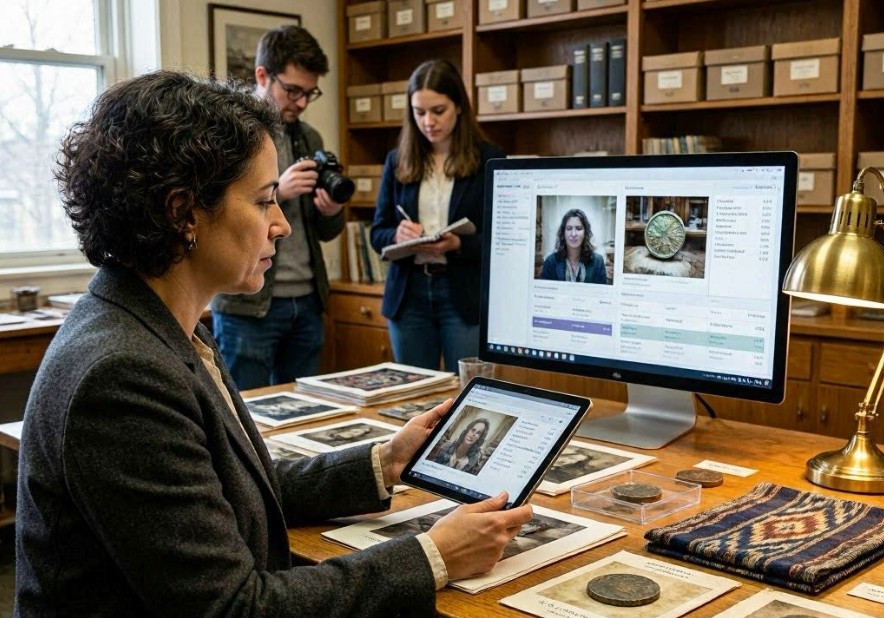
The system maps visual features into a high-dimensional representation and compares them to a timeline of known historical objects. This allows it to identify the closest matches in style and composition.
It can also detect hybrid characteristics that indicate transitional periods between historical eras.
Analysis workflow
- Image preprocessing and normalization
- Feature extraction from object surfaces
- Comparison with dated reference database
- Temporal probability estimation
- Final period classification
Why AI can sometimes outperform human experts
Human experts rely on experience and limited reference collections, while AI can process millions of images and detect patterns across vast datasets.
This allows the system to identify subtle correlations that may not be obvious even to trained historians, especially when dealing with rare or fragmented evidence.
Limitations of automated dating
Despite its accuracy, the system cannot replace contextual historical analysis. Without provenance or supporting documentation, visual dating alone may still produce uncertainty.
Additionally, objects that are deliberately styled to imitate older periods can mislead purely visual models.
Applications in archaeology and museums
Main uses
- Preliminary dating of undocumented artifacts
- Assistance in museum cataloging
- Verification of suspected forgeries
- Large-scale analysis of historical collections
Future of digital historical analysis
Future systems may integrate chemical simulation data, 3D scanning, and contextual historical records to produce even more precise reconstructions of artifact timelines.
Conclusion
Digital historians are transforming artifact analysis by turning photographic evidence into a powerful tool for estimating historical age, complementing and sometimes surpassing traditional expert methods.