

In recent years, there has been a significant advancement in the field of Artificial Intelligence (AI) and Augmented Reality (AR). These technologies have become increasingly popular and have the potential to enhance virtual experiences in various fields such as gaming, education, healthcare, and...
A Digital Meteorologist Predicts Frosts More Accurately Than Government Services
175
02.06.2026
Why frost prediction is so difficult
Frost formation depends on a delicate balance of temperature, humidity, wind speed, cloud cover, and ground conditions. Small local variations can determine whether frost appears in one field but not in another nearby area.
Traditional meteorological services rely on regional weather models that may not capture fine-grained microclimates, especially in rural or geographically complex areas.
This limitation can lead to forecast errors when conditions change rapidly overnight.
What a digital meteorologist is
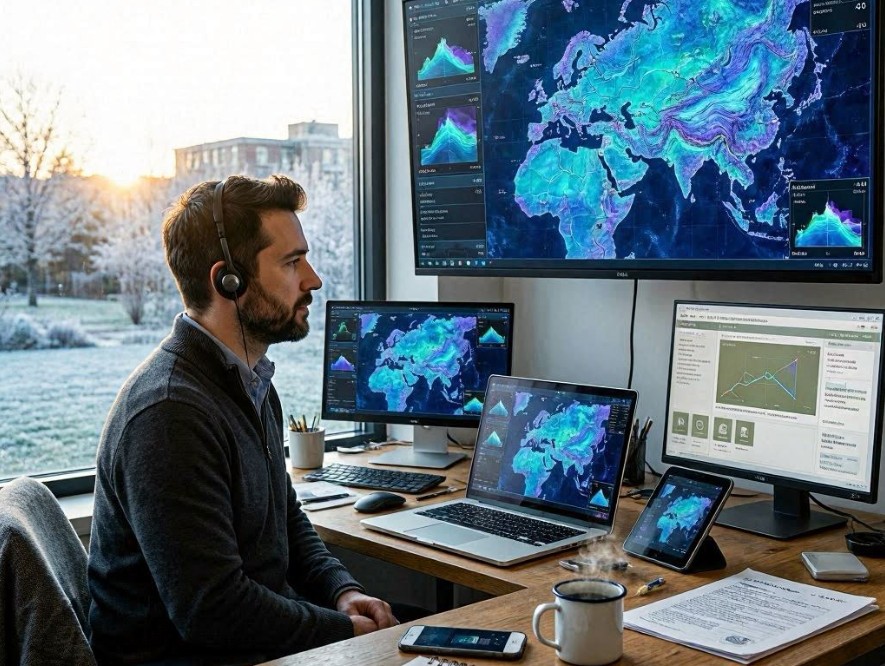
A digital meteorologist is an AI-based forecasting system that combines large-scale weather models with local sensor data to predict frost events at high spatial resolution.
Unlike conventional forecasting, it continuously learns from real-world outcomes to refine its predictions over time.
Main data sources
- Local temperature and humidity sensors
- Satellite weather observations
- Soil temperature measurements
- Wind and atmospheric pressure data
- Historical frost occurrence records
How the system predicts frost formation
The algorithm analyzes nighttime cooling patterns and identifies conditions where surface temperature is likely to drop below freezing. It also considers terrain features such as valleys and open fields where cold air tends to accumulate.
Machine learning models estimate frost probability for specific locations rather than broad regions.
Prediction workflow
- Collection of real-time environmental data
- Integration with weather simulation models
- Detection of high-risk cooling conditions
- Spatial frost risk mapping
- Continuous model refinement based on outcomes
Why AI can outperform traditional forecasts
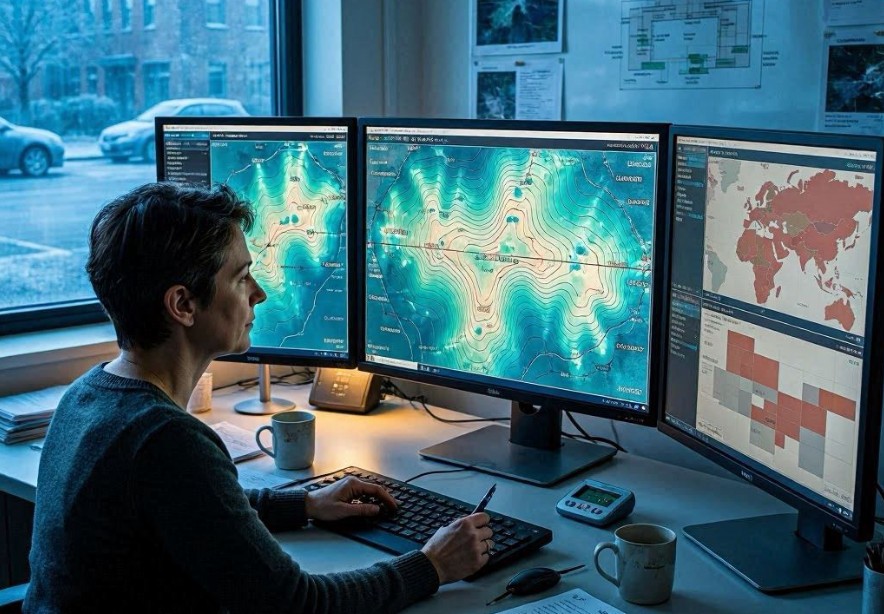
Government weather services typically operate on coarse grid models that prioritize national or regional forecasting. In contrast, AI systems can incorporate hyperlocal data from dense sensor networks.
This allows them to detect microclimate effects that significantly influence frost formation but are often invisible at larger scales.
Role of machine learning in frost prediction
Machine learning models identify complex nonlinear relationships between environmental variables. For example, a combination of clear skies, low wind, and dry soil may strongly increase frost risk even if temperatures are marginal.
The system improves over time as it learns from both correct and incorrect forecasts.
Key model capabilities
- Pattern recognition in historical frost events
- Real-time adjustment to changing weather conditions
- Location-specific risk scoring
- Short-term predictive refinement
Practical applications of frost prediction
Accurate frost forecasting is especially important for agriculture, where sudden temperature drops can damage crops and reduce yields.
Key use cases
- Protecting orchards and vineyards
- Optimizing irrigation and frost prevention systems
- Planning agricultural operations
- Supporting climate risk management
Limitations of digital meteorology
Despite improved accuracy, predictions are still probabilistic rather than absolute. Unexpected atmospheric shifts can still alter outcomes.
Sensor coverage gaps and hardware failures can also reduce reliability in some regions.
Future of AI-powered weather forecasting
Future systems may integrate drone-based atmospheric sampling, real-time satellite feeds, and fully adaptive climate models to deliver even more precise localized forecasts.
Conclusion
Digital meteorologists enhance frost prediction by combining local environmental sensing with machine learning, enabling more precise and actionable forecasts than traditional broad-scale systems.