

In recent years, there has been a significant advancement in the field of Artificial Intelligence (AI) and Augmented Reality (AR). These technologies have become increasingly popular and have the potential to enhance virtual experiences in various fields such as gaming, education, healthcare, and...
A Digital Zoologist Tracks Bird Migration in Real Time
144
08.06.2026
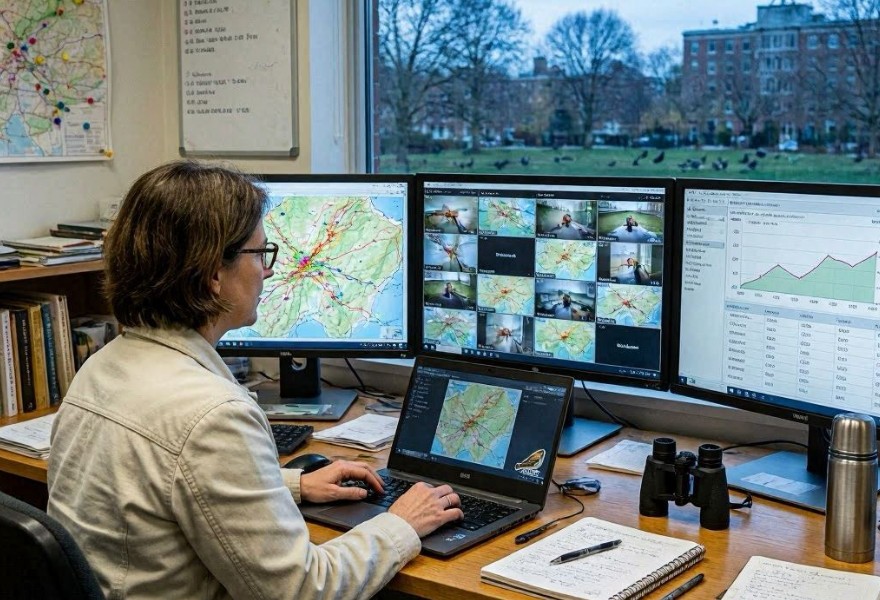
Why tracking bird migration is scientifically important
Bird migration is one of the most complex large-scale biological movements on Earth. Millions of birds travel across continents each year, following seasonal routes that depend on temperature, food availability, and wind patterns.
Understanding these routes is essential for biodiversity conservation, climate research, and ecosystem management.
However, traditional field observation methods are limited in scale and cannot continuously monitor migration across entire continents.
What a digital zoologist is
A digital zoologist is an AI-driven system that collects and analyzes biological and environmental data to monitor animal behavior in real time. In the case of birds, it integrates multiple data streams to track movement patterns across long distances.
Instead of relying on manual observation, it builds a continuously updating global map of migration activity.
Main data sources
- GPS and satellite tracking tags on birds
- Radar data detecting flock movements
- Acoustic sensors recording bird calls
- Weather and wind pattern data
- Historical migration databases
How real-time migration tracking works
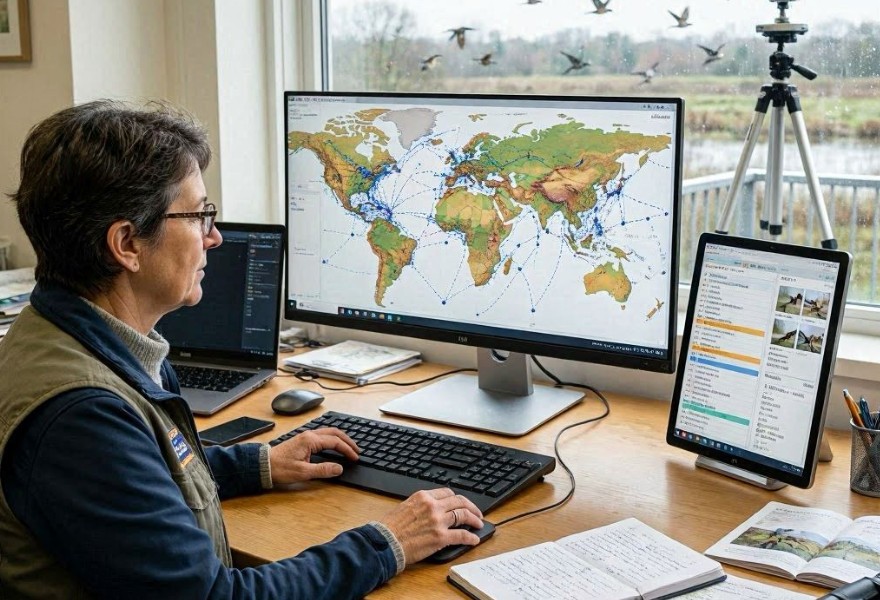
The system aggregates incoming signals from thousands of tracking devices and environmental sensors. It then reconstructs flight paths and predicts future movement based on environmental conditions.
Each bird or flock is represented as a dynamic data point moving across a global map.
Tracking workflow
- Continuous data ingestion from tracking devices
- Identification of species-specific movement patterns
- Clustering of flock behavior
- Trajectory reconstruction and smoothing
- Real-time visualization of migration routes
Role of artificial intelligence in migration analysis
Machine learning models analyze both current movement data and historical migration routes to predict where birds are likely to travel next. These models account for environmental variables such as wind currents, temperature changes, and food availability along the route.
AI also helps distinguish between different species and separates overlapping flocks in dense migration corridors.
Key analytical tasks
- Species classification from movement and acoustic patterns
- Trajectory prediction using temporal models
- Anomaly detection in migration behavior
- Environmental influence mapping
Why real-time tracking is valuable
Real-time migration data allows scientists to respond quickly to environmental threats such as habitat loss, extreme weather events, or illegal hunting activities along migration routes.
It also helps improve conservation strategies by identifying critical stopover points where birds rest and feed during long journeys.
Applications of digital zoology
Main uses
- Wildlife conservation planning
- Climate change impact studies
- Habitat protection and restoration
- Monitoring endangered species migration
Challenges in tracking bird migration
Despite advanced technology, tracking remains difficult due to device limitations, battery life constraints, and data gaps in remote regions.
Weather conditions and terrain can also interfere with signal transmission from tracking devices.
Main limitations
- Limited coverage in remote ecosystems
- Small sample sizes for tagged birds
- Data loss due to device failure
- Species that cannot be easily tagged
Future of AI-powered zoology
Future systems may integrate autonomous drones, advanced bio-sensors, and global satellite networks to create a near-complete real-time map of animal movement across the planet.
Conclusion
Digital zoologists are transforming wildlife research by enabling continuous, large-scale monitoring of bird migration, offering deeper insight into ecological systems and supporting global conservation efforts.