
In recent years, there has been a significant advancement in the field of Artificial Intelligence (AI) and Augmented Reality (AR). These technologies have become increasingly popular and have the potential to enhance virtual experiences in various fields such as gaming, education, healthcare, and...
A Neural Network Detects Weld Defects in Manufacturing More Accurately Than Humans
7
29.09.2026
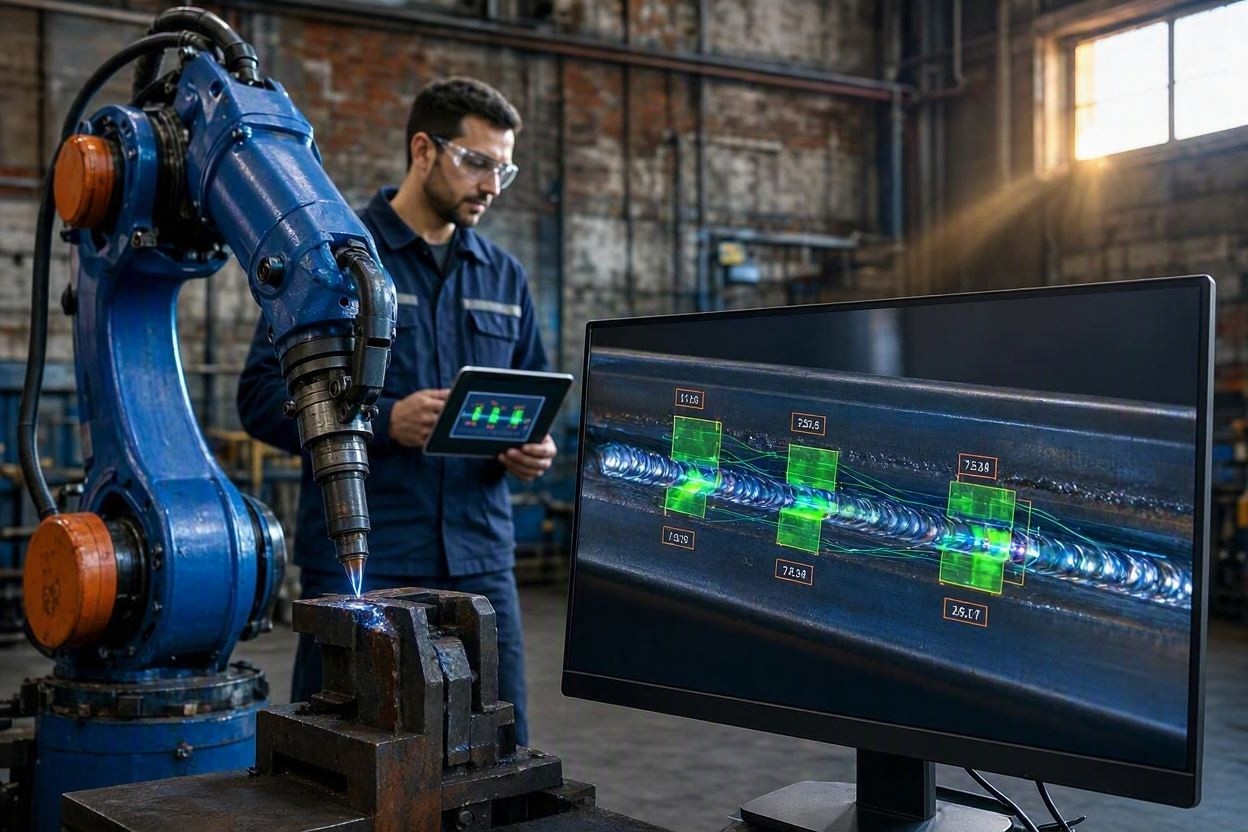
Weld quality is one of the most critical factors in modern manufacturing. A single hidden crack, pore, lack of fusion, or undercut can weaken a structure, shorten product life, and create serious safety risks. Traditionally, weld inspection has depended on trained human experts reviewing visual images, X-rays, ultrasonic scans, or other non-destructive testing data. While skilled inspectors remain essential, neural networks are now proving that they can detect weld defects with greater consistency and, in many cases, higher accuracy.
Why Weld Defect Detection Is Difficult
Welds are complex. Their appearance changes depending on material, joint geometry, heat input, filler metal, shielding gas, and welding position. Defects may be obvious on the surface or nearly invisible inside the joint. Even advanced inspection methods produce data that can be difficult to interpret under production pressure.
Human inspection has natural limits
Experienced inspectors bring judgment, context, and practical knowledge. However, fatigue, lighting conditions, image quality, repetitive work, and subjective interpretation can affect results. Two qualified inspectors may evaluate the same weld differently, especially when defects are small or borderline acceptable. In high-volume manufacturing, this variability becomes a major quality control challenge.
Small defects can create large consequences
In industries such as automotive, aerospace, shipbuilding, pressure vessels, pipelines, and heavy machinery, weld failures can be expensive or dangerous. Early detection helps manufacturers avoid rework, recalls, downtime, and liability. This is where artificial intelligence becomes valuable: it can analyze inspection data quickly and repeatedly without losing attention.
How Neural Networks Identify Weld Defects
A neural network is trained on large sets of labeled inspection data. These datasets may include photographs of weld beads, radiographic images, ultrasonic signals, thermographic data, or laser profiles. During training, the model learns patterns associated with acceptable welds and specific defect types.
From image recognition to industrial decision support
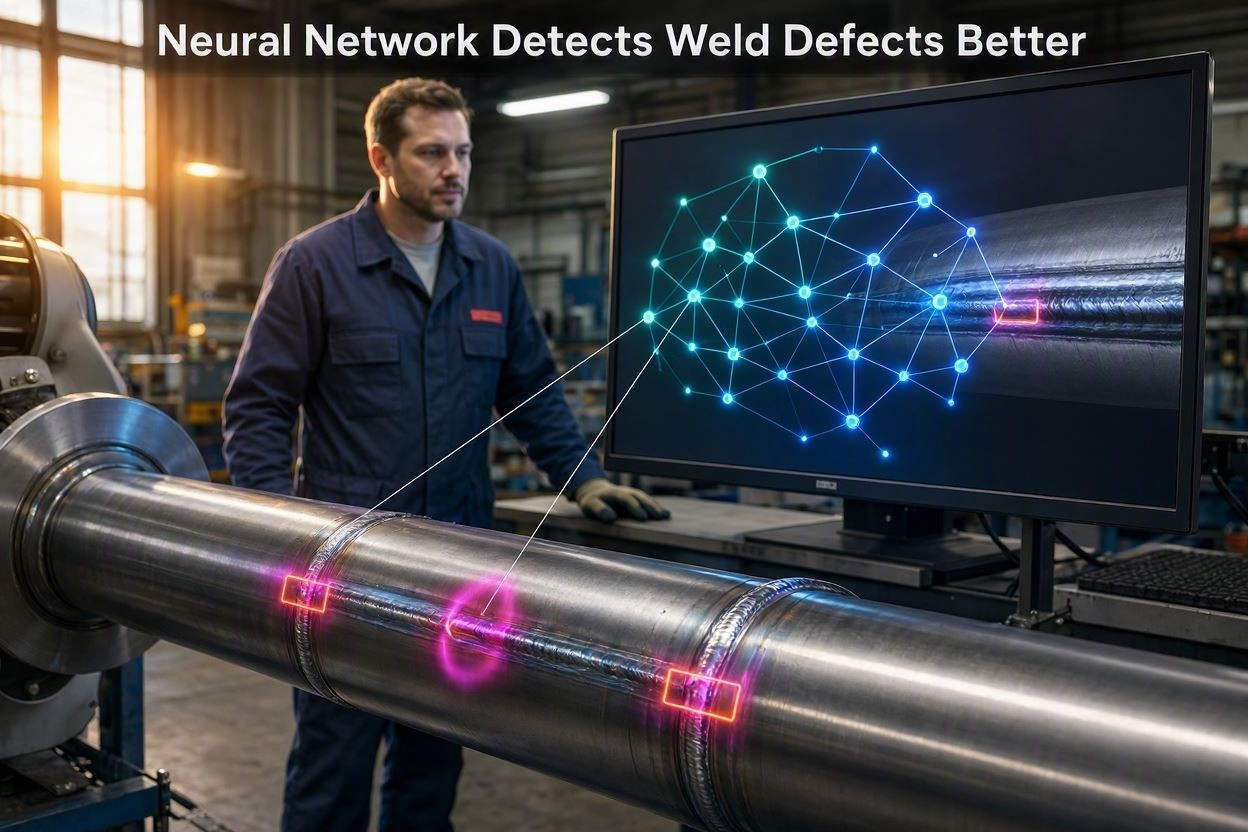
Convolutional neural networks are especially effective for visual and radiographic inspection because they can recognize shapes, textures, edges, and subtle contrasts. For example, pores may appear as dark rounded spots on an X-ray image, while cracks may form thin irregular lines. Instead of relying on fixed rules, the neural network learns these patterns from real examples.
Common defects AI can detect
- Porosity and gas pockets inside the weld metal
- Cracks on the surface or within the joint
- Lack of fusion between weld and base material
- Incomplete penetration at the root of the joint
- Undercut, overlap, spatter, and irregular bead geometry
- Burn-through and excessive reinforcement
Some systems also classify defect severity, estimate size, mark the defect location, and generate inspection reports. This turns raw inspection data into actionable quality information for engineers and production teams.
Why AI Can Be More Accurate Than Manual Inspection
The main advantage of a neural network is consistency. Once validated, the model applies the same evaluation logic to every weld. It does not become tired, distracted, or influenced by shift length. It can also process thousands of images in a fraction of the time required for manual review.
Better pattern recognition at scale
Neural networks can detect statistical patterns that are difficult for humans to notice, especially in noisy or low-contrast images. When trained with diverse data, they can distinguish harmless visual variations from real defects. This reduces false negatives, where a dangerous defect is missed, and false positives, where acceptable welds are unnecessarily rejected.
Real-time feedback for production
AI inspection can be integrated directly into welding lines. Cameras, sensors, and non-destructive testing equipment collect data immediately after or during welding. The neural network analyzes the result and alerts operators when a process begins to drift out of specification. Instead of finding problems at the end of production, manufacturers can correct parameters earlier.
Business Benefits for Manufacturers
Using neural networks for weld inspection is not only a technical upgrade. It can improve productivity, reduce scrap, and support compliance with strict quality standards. Automated detection also helps companies document inspection results more reliably.
- Higher detection accuracy for small or hidden defects
- Lower inspection time per component
- More consistent quality decisions across shifts and facilities
- Reduced rework, warranty claims, and material waste
- Improved traceability through digital inspection records
AI Does Not Replace Inspectors Completely
Despite its advantages, a neural network should not be treated as a standalone authority in critical manufacturing. The best results come from combining AI with expert oversight. Inspectors validate unusual findings, review edge cases, and ensure that the system follows applicable codes and acceptance criteria.
Data quality remains essential
An AI model is only as good as the data used to train and validate it. Manufacturers need representative datasets that include different materials, welding processes, thicknesses, defect types, and imaging conditions. Continuous monitoring is also important because production environments change over time.
The Future of Weld Quality Control
Neural network-based weld inspection is moving manufacturing toward predictive quality control. Instead of only detecting defects after they occur, future systems will connect inspection results with welding parameters, equipment condition, and operator inputs. This will help predict when defects are likely to appear and recommend corrective actions automatically.
For manufacturers, the message is clear: AI-powered weld defect detection can deliver higher accuracy, faster inspection, and more reliable quality control than manual methods alone. Human expertise remains vital, but neural networks are becoming an essential tool for safer, smarter, and more competitive production.