
In recent years, there has been a significant advancement in the field of Artificial Intelligence (AI) and Augmented Reality (AR). These technologies have become increasingly popular and have the potential to enhance virtual experiences in various fields such as gaming, education, healthcare, and...
A Neural Network Predicts City Electricity Consumption Hour by Hour
56
25.10.2026

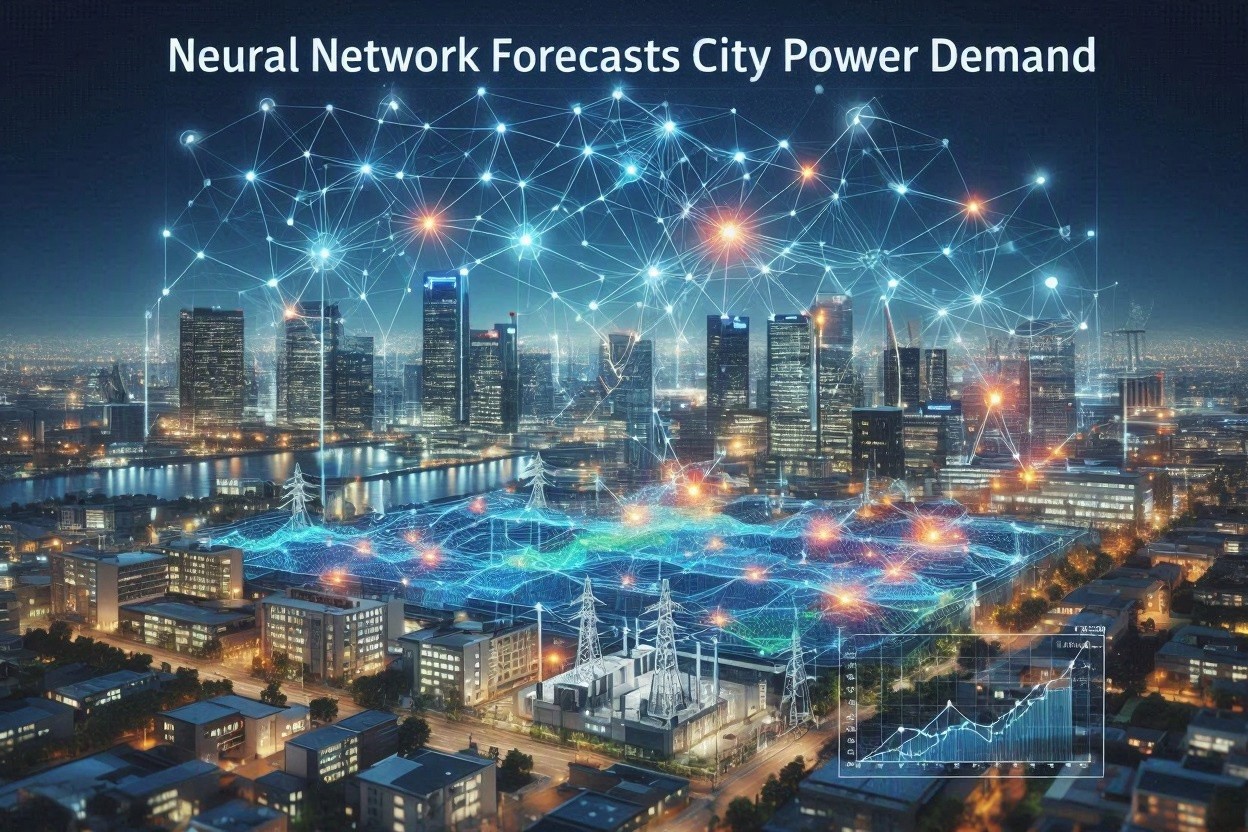
Accurate electricity forecasting has become a strategic task for modern cities. As transportation, heating, cooling, industry, and digital services depend on stable power, grid operators need to know not only how much electricity a city will use tomorrow, but how demand will change from one hour to the next. A neural network designed for hourly electricity consumption prediction can give utilities, municipalities, and energy traders the visibility they need to manage supply efficiently and avoid costly imbalances.
Why Hourly Electricity Forecasting Matters
Electricity cannot be stored at city scale as easily as water or fuel. Supply and demand must remain balanced almost continuously. If demand is underestimated, operators may need to buy expensive emergency power or rely on backup plants. If demand is overestimated, generators may run unnecessarily, increasing costs and emissions.
Hourly forecasts are especially valuable because urban consumption is highly dynamic. Morning routines, office activity, public transport, weather shifts, and evening residential use all create predictable but complex patterns. A daily forecast may say that a city will use 120 gigawatt-hours, but it cannot show whether the peak will occur at 8 a.m., 6 p.m., or during a heatwave in the afternoon. Hour-by-hour prediction solves this gap.
How a Neural Network Learns City Demand Patterns
A neural network is trained on historical electricity consumption and related external data. Instead of following a fixed formula, it learns relationships from examples. Over time, it detects patterns that are difficult for traditional statistical models to capture, especially when many factors interact at once.
Key Input Data
The quality of a forecast depends heavily on the data used for training. Common inputs include:
- Historical hourly electricity load across the city or grid zone
- Temperature, humidity, wind speed, and cloud cover
- Calendar features such as weekdays, weekends, and holidays
- Business hours, school schedules, and public events
- Solar generation estimates and other distributed energy sources
- Long-term trends such as electrification of transport or heating
For example, two days with the same temperature may still produce different demand if one is a Sunday and the other is a working Monday. A well-trained neural network can learn these subtle distinctions and adjust the hourly forecast accordingly.
Model Architecture
Several neural network architectures can be used for this task. Recurrent neural networks and long short-term memory models are suitable for time series because they consider previous hours when predicting future consumption. More recently, transformer-based models have gained attention because they can analyze long sequences of data and identify dependencies across days, weeks, and seasons.
In practice, many energy teams use hybrid systems. A neural network may handle complex nonlinear relationships, while statistical methods or rule-based checks provide stability and interpretability. This combination often improves reliability in real-world grid operations.
Benefits for Utilities and City Planners
When a neural network predicts electricity consumption hour by hour, the benefits extend beyond technical forecasting. It supports better decision-making across the entire urban energy system.
Lower Operating Costs
More accurate forecasts allow utilities to schedule generation and power purchases closer to actual needs. This reduces dependence on high-cost balancing markets and helps avoid inefficient operation of standby plants.
Better Use of Renewable Energy
Solar and wind power add variability to the grid. If a city knows when demand will rise and how renewable output is expected to change, operators can plan storage, demand response, and flexible generation more effectively. This makes it easier to integrate clean energy without compromising reliability.
Improved Peak Demand Management
Peak demand hours are expensive and stressful for grid infrastructure. Hourly predictions help identify upcoming peaks in advance. Utilities can then encourage large consumers to shift usage, activate battery storage, or adjust pricing signals to reduce pressure on the network.
Challenges and Limitations
Neural networks are powerful, but they are not magic. Forecast accuracy can decline when the city experiences unusual events that are poorly represented in historical data. Extreme weather, sudden industrial shutdowns, major festivals, or policy changes can all disrupt expected consumption patterns.
Data quality is another critical issue. Missing meter readings, inconsistent weather data, or changes in measurement systems can mislead the model. Successful implementation requires continuous data validation, model monitoring, and periodic retraining.
Explainability and Trust
Grid operators must trust the forecast before using it for operational decisions. Because neural networks can be difficult to interpret, many teams add explainability tools that show which variables influenced the prediction. For example, the system may highlight that a forecasted evening peak is driven by low temperature, weekday behavior, and reduced local solar production.
What an Effective Forecasting Workflow Looks Like
A practical hourly forecasting system usually follows a structured process:
- Collect and clean historical load, weather, and calendar data.
- Train the neural network on multiple years of hourly records.
- Validate the model against recent unseen periods.
- Generate forecasts for the next 24 to 168 hours.
- Compare predictions with real consumption and retrain when needed.
This workflow turns forecasting into a continuous learning cycle. The model becomes more useful as it receives new data and adapts to changes in the city’s behavior.
The Future of Urban Energy Forecasting
As cities electrify buses, cars, heating systems, and industrial processes, hourly electricity consumption will become even more complex. Neural networks will play an important role in managing this complexity. They can help cities move from reactive grid management to proactive energy planning, where demand, supply, storage, and flexible consumption are coordinated in advance.
A neural network that predicts city electricity consumption hour by hour is not just a technical innovation. It is a practical tool for lowering costs, strengthening reliability, and accelerating the transition to cleaner urban energy systems.