

In recent years, there has been a significant advancement in the field of Artificial Intelligence (AI) and Augmented Reality (AR). These technologies have become increasingly popular and have the potential to enhance virtual experiences in various fields such as gaming, education, healthcare, and...
A Neural Network Predicts Heart Attacks a Week in Advance from a Person’s Voice
145
09.06.2026
Why voice can contain health signals
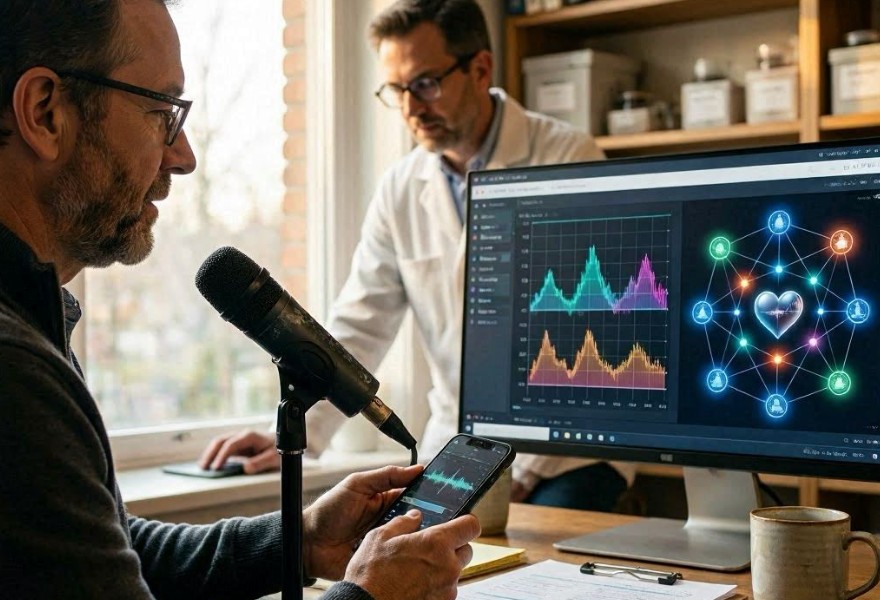
Human speech is not only a linguistic output but also a physiological one. It is shaped by breathing patterns, muscle control, hydration levels, and nervous system activity.
Subtle changes in these systems—especially those involving the cardiovascular and autonomic nervous systems—can influence vocal characteristics long before obvious symptoms appear.
This makes voice a potential non-invasive signal for early health screening.
What the neural network analyzes in speech
The system processes short voice recordings and extracts acoustic features that are not perceptible to the human ear. These features reflect micro-variations in tone, stability, and rhythm of speech.
Key vocal biomarkers
- Pitch variability and instability
- Speech rate and pauses
- Micro-tremors in frequency
- Breath control patterns
- Energy distribution across frequencies
How prediction of heart attack risk works
The neural network is trained on large datasets of voice recordings paired with medical outcomes. It learns patterns that statistically correlate with cardiovascular events occurring days or weeks later.
Instead of diagnosing disease directly, the system estimates risk probability based on detected deviations from a person’s baseline voice profile.
Prediction workflow
- Baseline voice profile creation
- Continuous or periodic voice sampling
- Feature extraction from audio signals
- Comparison with learned risk patterns
- Generation of early warning score
Why voice changes may precede cardiac events
Cardiovascular stress can affect oxygen circulation, fatigue levels, and autonomic regulation, all of which influence speech production. These changes may be subtle but measurable in acoustic data.
Inflammation, stress hormones, and reduced physical resilience can also contribute to detectable vocal shifts.
Role of machine learning in early detection
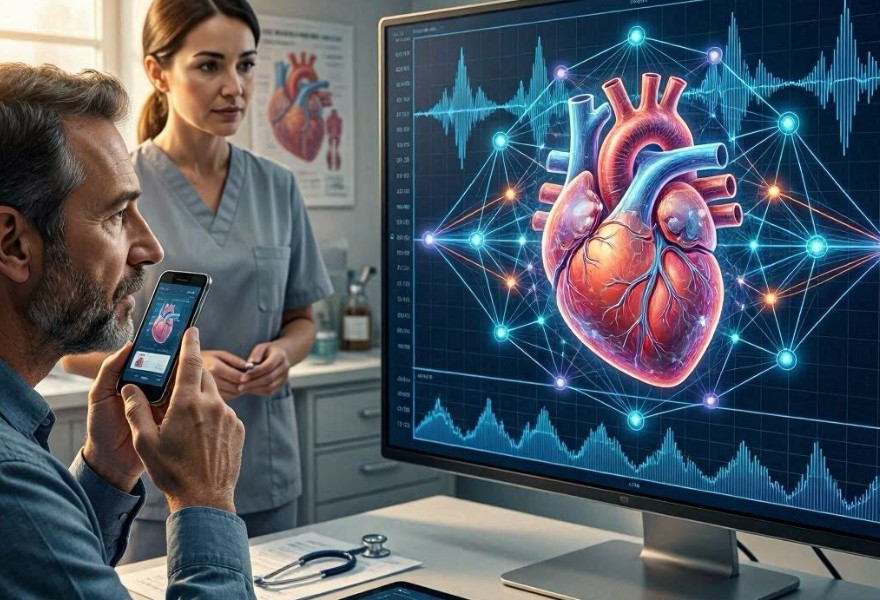
Machine learning models excel at identifying complex, nonlinear relationships between physiological signals and outcomes. In this case, they correlate patterns in voice data with historical cases of cardiac events.
The model continuously improves as more labeled health data becomes available.
Model capabilities
- Personalized baseline comparison
- Detection of gradual vocal drift
- Risk scoring over time
- Adaptation to individual speech patterns
Potential applications in healthcare
Main uses
- Early warning systems for high-risk patients
- Remote health monitoring via smartphones
- Preventive cardiology screening tools
- Support for telemedicine diagnostics
Limitations and medical caution
Voice-based prediction is probabilistic and not a substitute for clinical diagnosis. Many factors—such as fatigue, illness, or emotional stress—can temporarily alter speech without indicating cardiovascular risk.
False positives and false negatives remain an important challenge in real-world deployment.
Future of voice-based medical AI
Future systems may combine voice analysis with wearable sensors, ECG data, and continuous health monitoring to create multi-modal predictive healthcare platforms.
Conclusion
Neural networks analyzing voice patterns represent a promising direction in preventive medicine, offering the possibility of detecting serious health risks before symptoms become critical.