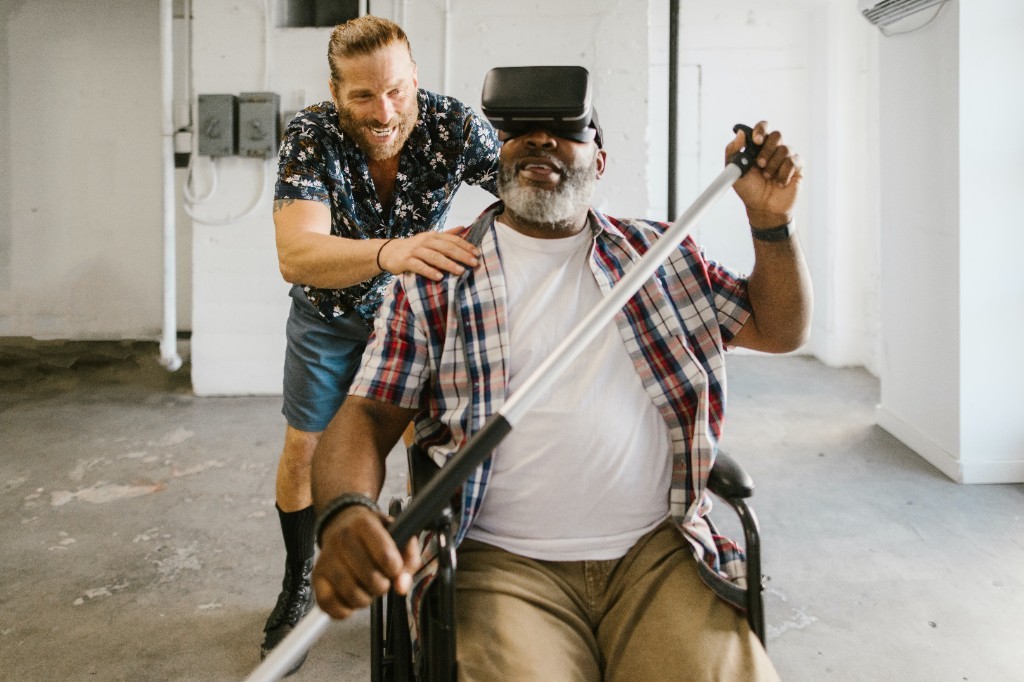

In recent years, there has been a significant advancement in the field of Artificial Intelligence (AI) and Augmented Reality (AR). These technologies have become increasingly popular and have the potential to enhance virtual experiences in various fields such as gaming, education, healthcare, and...
A Neural Network Restores Lost Frames from Silent Films
164
15.06.2026
Why silent films lose frames over time
Silent films, especially those produced in the late 19th and early 20th centuries, were recorded on nitrate film stock, which is highly fragile and chemically unstable. Over decades, many reels have deteriorated, burned, or been partially lost.
As a result, surviving copies often contain missing frames, flickering sequences, or damaged sections that disrupt continuity.
Film preservationists traditionally reconstruct these gaps manually, but this process is slow and often incomplete.
What the neural network does
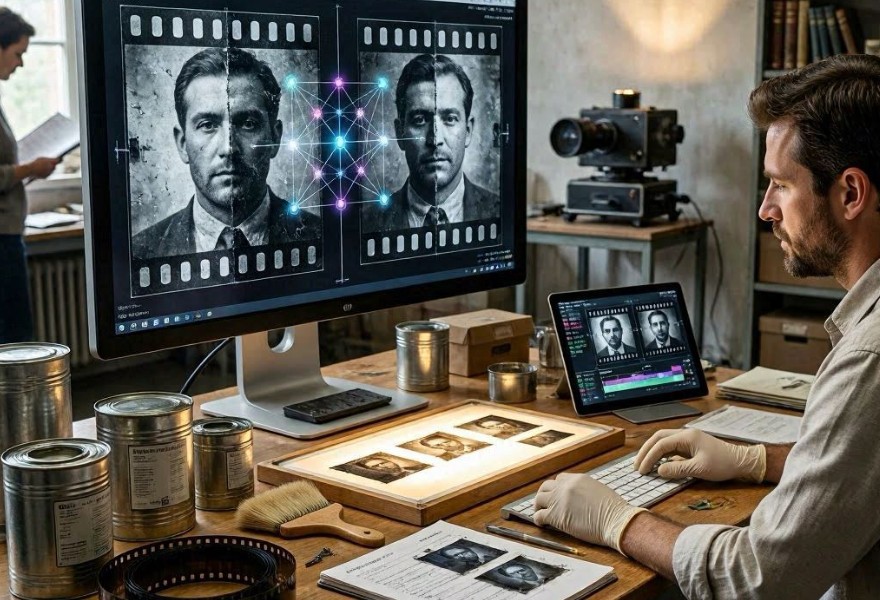
A neural network designed for film restoration analyzes existing frames to predict and generate missing intermediate frames. It reconstructs temporal motion by learning how objects, faces, and scenes evolve across time.
The goal is not to invent new content, but to restore continuity based on learned motion patterns and historical visual context.
Main input data
- Adjacent surviving film frames
- Motion trajectories of objects and actors
- Film grain and lighting characteristics
- Historical footage from the same era and studio
How frame reconstruction works
The system uses temporal interpolation and generative modeling to estimate what missing frames likely looked like between two known frames.
It analyzes motion flow, object deformation, and scene geometry to maintain continuity across time.
Reconstruction workflow
- Frame extraction from degraded film reels
- Detection of missing or damaged segments
- Optical flow estimation between frames
- Generation of intermediate frames
- Consistency correction with surrounding footage
Role of artificial intelligence in restoration
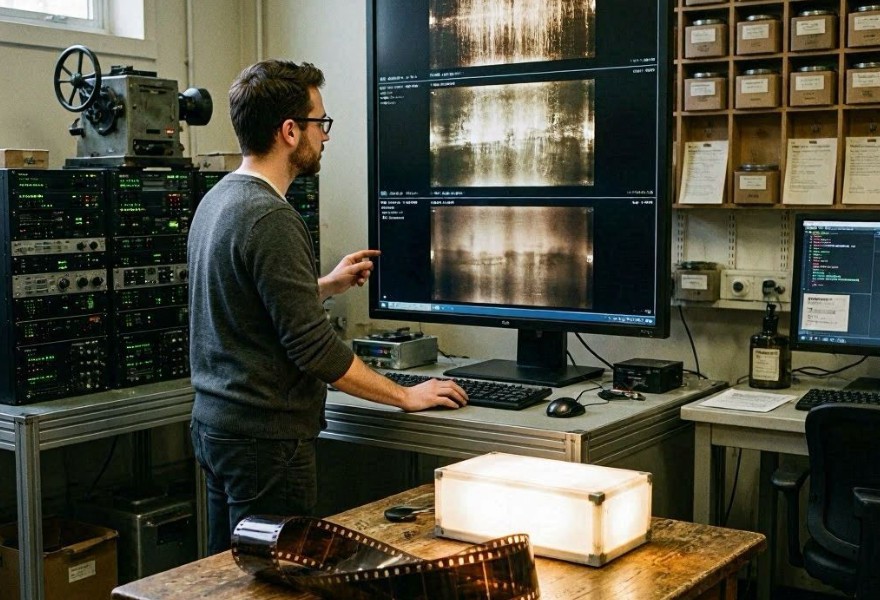
Deep learning models trained on large video datasets learn how motion behaves in real-world scenes. These models can infer plausible transitions even when large portions of footage are missing.
In silent film restoration, AI also learns stylistic elements such as frame rate inconsistencies, camera artifacts, and historical lighting conditions.
Key capabilities
- Temporal interpolation of missing frames
- Noise and scratch removal
- Motion consistency correction
- Style preservation of early cinema aesthetics
Why AI improves film restoration
Manual restoration relies heavily on human interpretation and can introduce inconsistencies in motion or pacing. Neural networks provide a data-driven approach that maintains smoother temporal continuity.
This is especially valuable when large sections of footage are missing and must be inferred rather than repaired.
Applications in cultural preservation
Main uses
- Restoration of early silent cinema archives
- Digital preservation of fragile historical films
- Reconstruction of partially lost movie reels
- Enhanced viewing experiences for modern audiences
Limitations of AI film restoration
AI-generated frames are approximations based on learned patterns, not original recorded content. This introduces a level of uncertainty, especially in scenes with complex or unusual motion.
There is also a risk of over-smoothing or altering artistic intent if models are not carefully constrained.
Future of film restoration technology
Future systems may integrate higher-fidelity motion capture models, director-style analysis, and multi-source archival comparison to produce even more accurate restorations of historical films.
Conclusion
Neural networks are transforming silent film restoration by reconstructing missing frames and restoring visual continuity, helping preserve early cinematic heritage for future generations.