

In recent years, there has been a significant advancement in the field of Artificial Intelligence (AI) and Augmented Reality (AR). These technologies have become increasingly popular and have the potential to enhance virtual experiences in various fields such as gaming, education, healthcare, and...
A Program Helps Geologists Interpret Seismic Survey Data Faster
37
20.09.2026
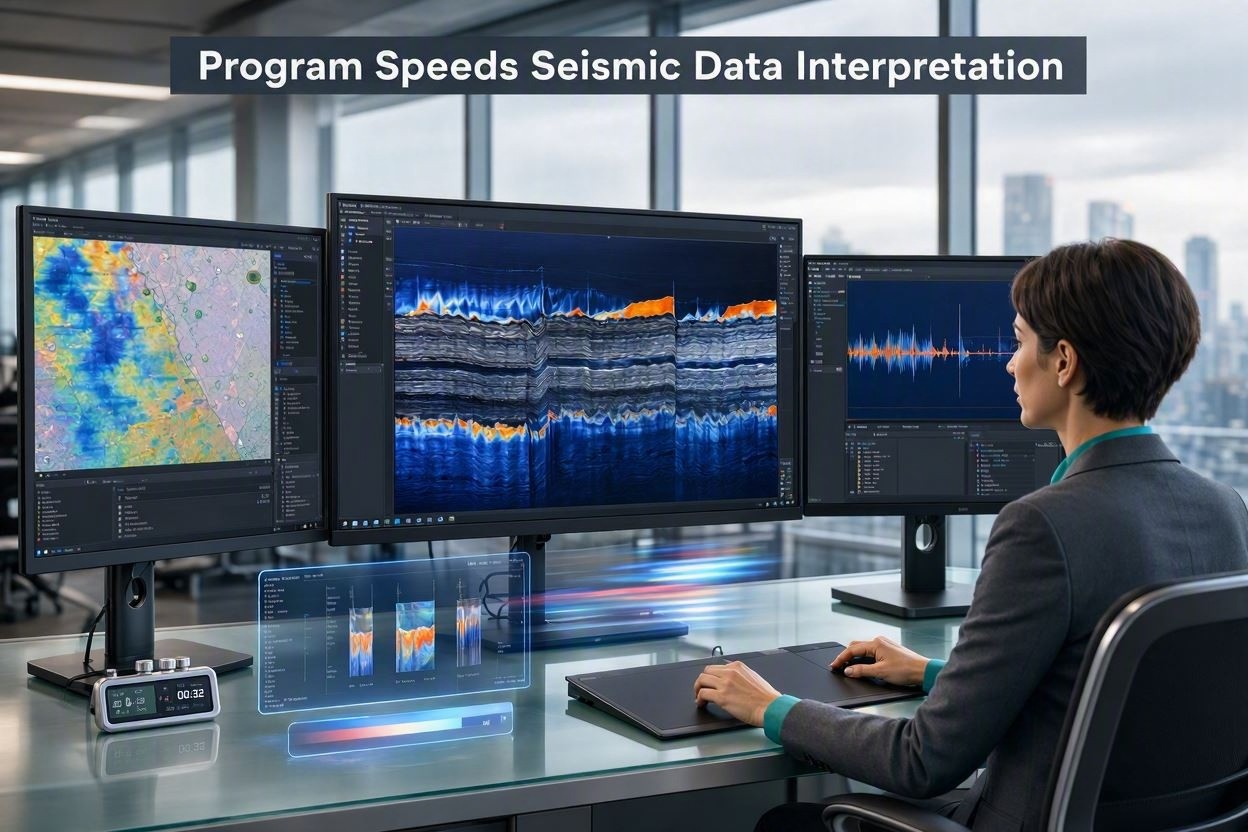
Seismic survey interpretation is one of the most time-sensitive and data-heavy tasks in subsurface exploration. A modern interpretation program can help geologists move from raw seismic volumes to reliable geological insight faster, without sacrificing technical rigor. By combining automated signal analysis, machine learning, visualization, and quality control tools, such software reduces repetitive manual work and gives specialists more time to evaluate geological meaning.
Why Seismic Interpretation Takes So Much Time
Seismic surveys generate enormous datasets. A single 3D seismic volume may contain millions of traces, complex reflections, noise, acquisition artifacts, and subtle structural features. Geologists and geophysicists must identify horizons, faults, stratigraphic patterns, amplitudes, and velocity-related distortions before they can build a trustworthy subsurface model.
Traditional interpretation relies heavily on manual picking and cross-checking. Experienced interpreters can recognize patterns quickly, but the process is still demanding. The challenge is not only to find features, but to distinguish meaningful geological signals from processing effects or random noise. This is where specialized software brings measurable value.
How the Program Accelerates Geological Workflows
Automated Horizon and Fault Detection
One of the most useful functions is automated event tracking. The program can follow continuous seismic reflectors across large volumes and propose horizon picks in seconds or minutes. Fault detection algorithms highlight discontinuities, breaks, and offsets that may indicate structural boundaries. The geologist remains in control, but the software provides an informed starting point.
This is especially valuable in structurally complex basins, where faults intersect, reflectors terminate, or seismic quality changes rapidly. Instead of drawing every feature manually, specialists review, adjust, and validate the program’s suggestions.
Attribute Analysis and Pattern Recognition
Seismic attributes such as coherence, amplitude, phase, frequency, curvature, and sweetness help reveal geological relationships that may not be obvious in standard amplitude displays. A well-designed interpretation program calculates these attributes efficiently and displays them in linked views.
Machine learning tools can also classify seismic facies, identify channels, map carbonate buildups, or detect potential reservoir bodies. These models do not replace geological judgment, but they help interpreters screen large areas and focus attention on the most promising zones.
Key Benefits for Exploration and Development Teams
- Faster project turnaround: automated picking and volume scanning reduce the time needed for initial interpretation.
- Improved consistency: algorithms apply the same criteria across the dataset, limiting interpreter bias.
- Better risk assessment: clearer structural and stratigraphic models support stronger drilling decisions.
- Efficient collaboration: shared visualization and version control help geologists, geophysicists, and reservoir engineers work from the same model.
- Higher data value: teams can extract more information from existing seismic surveys before commissioning new acquisition.
What Makes the Software Reliable
Integration With Geological Knowledge
The best programs are not black boxes. They allow users to incorporate well logs, checkshots, velocity models, core descriptions, and regional geological concepts. This integration helps ensure that seismic interpretation is tied to real rock properties and not limited to visual pattern matching.
For example, a horizon interpreted on seismic data can be calibrated to formation tops from wells. Amplitude anomalies can be compared with petrophysical data. Fault interpretations can be tested against production behavior or pressure compartments. The program becomes most powerful when it connects geophysical evidence with geological constraints.
Quality Control and Uncertainty Management
Speed is useful only when results remain dependable. Advanced tools provide uncertainty maps, confidence scores, pick-density checks, and comparison between manual and automated interpretations. These features help teams understand where the model is strong and where more review is required.
In practice, geologists should treat automated outputs as hypotheses. The program accelerates discovery, but expert validation remains essential. Interpreters must consider seismic resolution, acquisition footprint, processing history, and local depositional setting before making final conclusions.
Practical Use Cases
- Frontier basin screening: rapid mapping of major structures and depositional trends across broad areas.
- Field development planning: detailed fault and horizon interpretation for well placement and reservoir compartmentalization.
- Carbon storage evaluation: assessment of seals, traps, faults, and monitoring targets in potential storage sites.
- Geothermal exploration: identification of fracture zones, heat-related structures, and reservoir geometry.
The Future of Seismic Interpretation
As seismic datasets continue to grow, interpretation programs will become even more important. Cloud computing, artificial intelligence, and real-time collaborative platforms are changing how subsurface teams work. Future systems will likely combine seismic data, well information, geomechanics, production history, and basin models in a single environment.
The main advantage is not simply faster clicking or automated mapping. The real value is better decision-making. A program that helps geologists interpret seismic survey data faster allows experts to test more ideas, compare more scenarios, and reduce uncertainty before costly field operations begin.
Used correctly, this technology strengthens the role of the geologist. It handles repetitive tasks, exposes hidden patterns, and supports disciplined interpretation. Human expertise remains the final authority, but software makes that expertise more productive, more transparent, and more responsive to the demands of modern exploration.