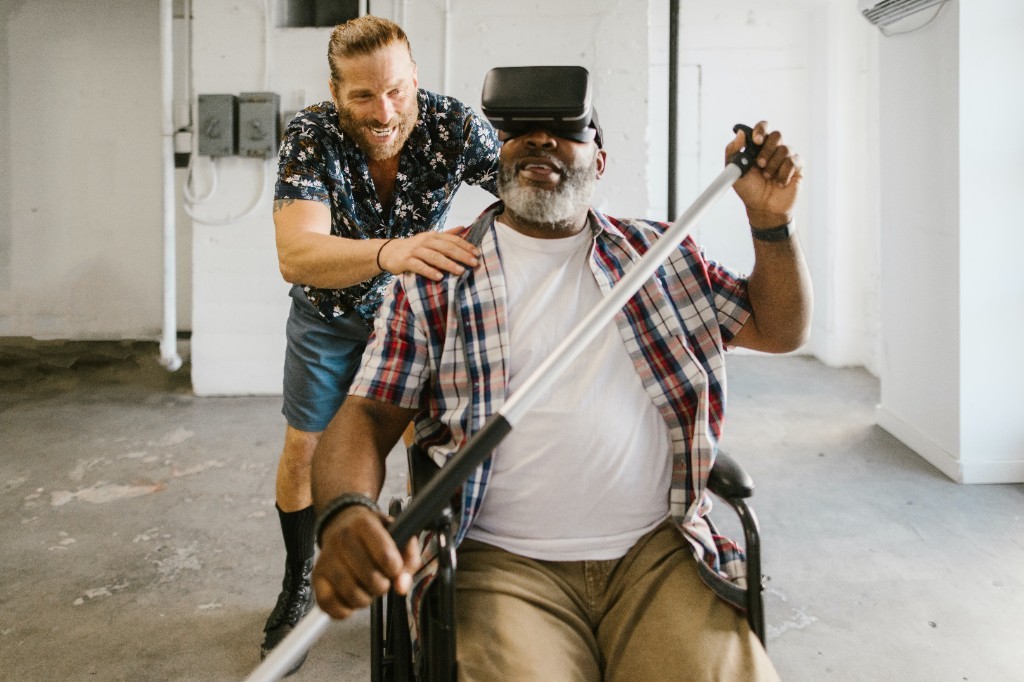

In recent years, there has been a significant advancement in the field of Artificial Intelligence (AI) and Augmented Reality (AR). These technologies have become increasingly popular and have the potential to enhance virtual experiences in various fields such as gaming, education, healthcare, and...
A Program Translates Sign Language into Text in Real Time
168
01.06.2026

Why real-time sign language translation matters
Communication barriers between deaf or hard-of-hearing individuals and those who do not know sign language remain a significant social challenge. Traditional interpretation requires trained human interpreters, which are not always available.
Real-time digital translation systems aim to reduce this gap by providing instant conversion of sign language into readable text.
This technology improves accessibility in education, healthcare, public services, and everyday communication.
How the system captures sign language
The program uses cameras or depth sensors to track hand movements, facial expressions, and body posture. These visual inputs are processed frame by frame to detect meaningful gestures.
Unlike simple motion detection, the system must understand complex combinations of movement, timing, and spatial positioning.
Main input sources
- Hand shape and finger positioning
- Arm movement trajectories
- Facial expressions (grammar and emotion markers)
- Body posture and orientation
How AI interprets gestures
A machine learning model trained on large datasets of sign language videos maps visual patterns to linguistic units such as words or phrases. These units are then assembled into coherent sentences.
The system continuously processes incoming frames to ensure smooth and uninterrupted translation.
Processing pipeline
- Video capture and frame extraction
- Hand and body keypoint detection
- Gesture classification
- Language modeling for sentence construction
- Real-time text output generation

Why sign language translation is complex
Sign languages are not direct visual versions of spoken languages. They have their own grammar, syntax, and regional variations.
Additionally, meaning often depends on context, facial expression, and subtle movement differences that must all be interpreted together.
Role of deep learning models
Deep neural networks, especially convolutional and transformer-based architectures, are used to recognize patterns in motion sequences. These models learn temporal relationships between gestures rather than analyzing single frames independently.
This allows the system to understand full sentences rather than isolated signs.
Benefits of real-time translation systems
Main advantages
- Immediate communication without human interpreters
- Improved accessibility in public spaces
- Support for education and remote learning
- Increased independence for deaf users
Limitations of current technology
Accuracy can decrease in poor lighting conditions or when multiple people are present in the frame. Some regional sign language variations may also not be fully supported.
In addition, highly expressive or nuanced communication may still require human interpretation for full accuracy.
Future of sign language AI systems
Future developments may include wearable devices, improved 3D motion capture, and bidirectional translation systems that convert spoken language into sign language avatars in real time.
Conclusion
AI-powered sign language translation programs represent a major step toward inclusive communication, enabling real-time understanding between sign language users and the wider world.