
In recent years, there has been a significant advancement in the field of Artificial Intelligence (AI) and Augmented Reality (AR). These technologies have become increasingly popular and have the potential to enhance virtual experiences in various fields such as gaming, education, healthcare, and...
A Smart Alarm Clock Analyzes Sleep Phases and Wakes You at the Best Moment
228
29.05.2026
Why waking up at the wrong time feels so hard
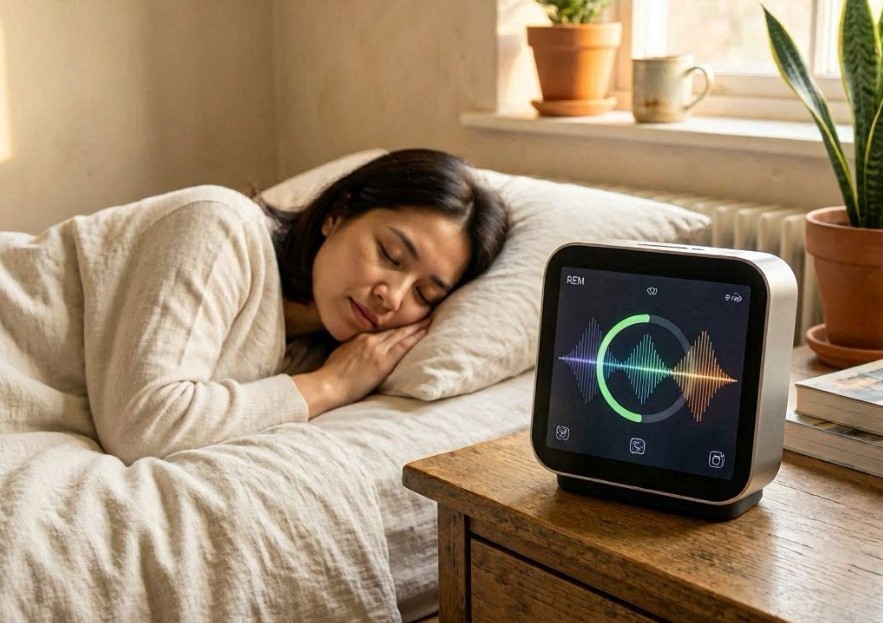
Human sleep is structured into cycles consisting of light sleep, deep sleep, and REM phases. Waking up during deep sleep often results in grogginess, reduced alertness, and a phenomenon known as sleep inertia.
Traditional alarm clocks ignore sleep structure and simply trigger at a fixed time, regardless of where the user is in their sleep cycle.
This mismatch between biological rhythm and external scheduling is what smart alarm systems aim to solve.
How a smart alarm clock tracks sleep phases
A smart alarm clock uses sensors embedded in wearable devices, mattresses, or bedside systems to estimate the user’s sleep stage in real time. It does not directly measure brain activity like clinical EEG, but infers sleep phases from motion, heart rate, and breathing patterns.
Data sources used for analysis
- Heart rate variability
- Body movement and restlessness
- Respiratory rate
- Sound patterns during sleep
How the algorithm determines the best wake-up moment
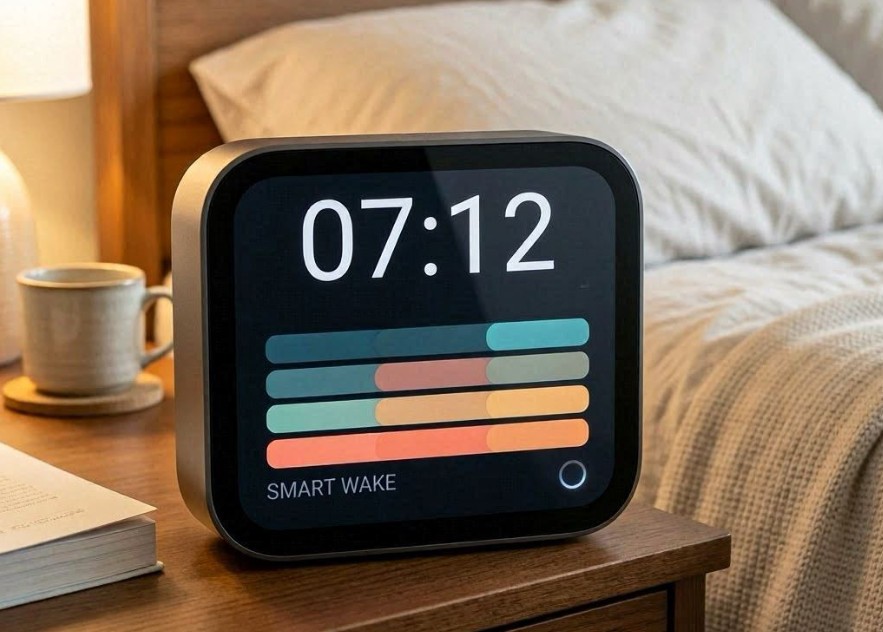
The system continuously predicts transitions between sleep phases and identifies upcoming light sleep windows. It then selects a wake-up time within a predefined interval that minimizes disruption to deep sleep.
This ensures the user is more likely to wake up naturally and feel alert.
Decision process
- Continuous sleep stage estimation
- Detection of upcoming light sleep phase
- Comparison with user-defined alarm window
- Selection of optimal wake-up moment
- Gradual alarm activation
Role of artificial intelligence in sleep analysis
Machine learning models are trained on large datasets of sleep recordings to recognize patterns associated with different sleep stages. Over time, the system adapts to individual sleep behavior, improving accuracy for each user.
This personalization is crucial, as sleep patterns vary significantly between individuals.
How smart alarms improve waking experience
Instead of a sudden loud sound, smart alarms often use gradual stimulation such as increasing light intensity, gentle vibration, or soft audio cues synchronized with sleep state.
Benefits of optimized waking
- Reduced morning grogginess
- Improved mood upon waking
- Better cognitive performance early in the day
- More consistent sleep schedules
Limitations of sleep phase detection
Although smart alarms are effective, they do not measure brain activity directly, so sleep stage estimation is approximate rather than clinical-grade.
External factors like stress, illness, or alcohol consumption can also reduce accuracy.
Future of intelligent sleep systems
Future systems may integrate EEG headbands, environmental control (temperature and humidity adjustment), and AI-driven sleep coaching to optimize not only waking time but overall sleep quality.
Conclusion
Smart alarm clocks represent a shift from rigid time-based waking to biologically aware systems that align alarms with natural sleep cycles, improving daily energy and well-being.