

In recent years, there has been a significant advancement in the field of Artificial Intelligence (AI) and Augmented Reality (AR). These technologies have become increasingly popular and have the potential to enhance virtual experiences in various fields such as gaming, education, healthcare, and...
AI-Designed Glass Coating Collects Water From the Air
38
03.09.2026
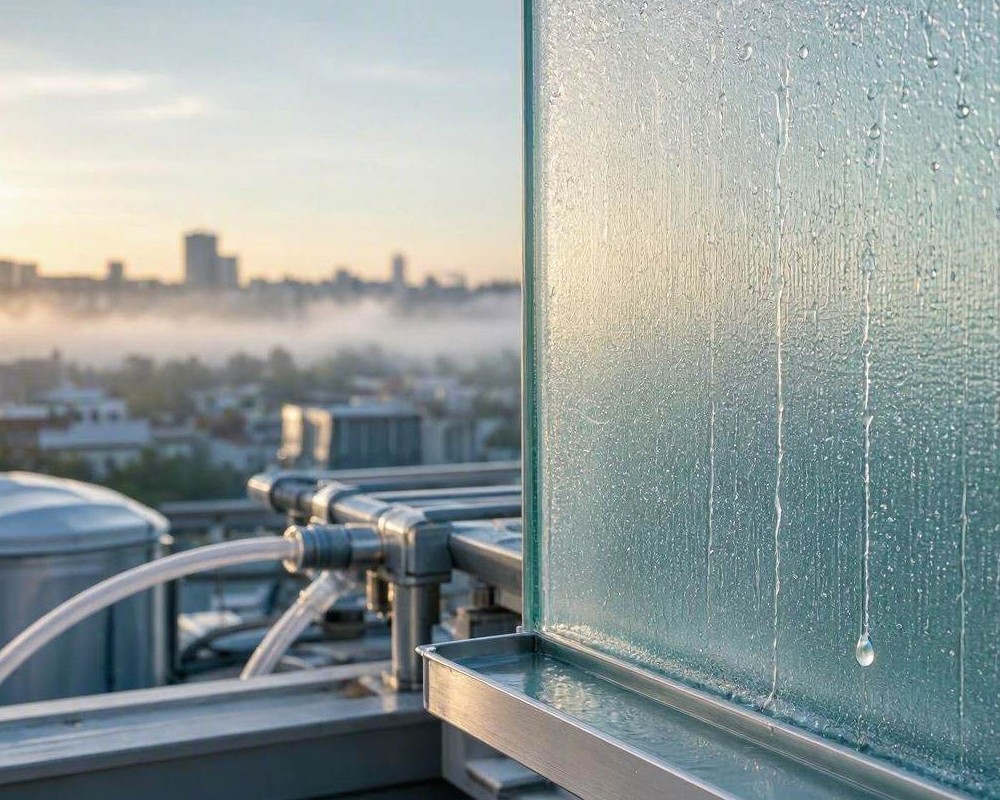
Artificial intelligence is helping scientists develop a glass coating capable of harvesting water directly from humid air. Rather than generating water, the material encourages atmospheric vapor to condense into liquid droplets that can be collected. Its carefully optimized optical properties allow the glass to remain cooler than the surrounding air, creating favorable conditions for condensation without relying on energy-intensive refrigeration.
The innovation could support decentralized water production in regions where humidity is available but clean water infrastructure is limited. It may also improve greenhouse irrigation, industrial moisture recovery, and water collection in remote locations. However, its output depends on weather conditions, surface area, and the efficiency of the complete harvesting system.
How the Water-Harvesting Glass Works
The coating uses passive radiative cooling. Every surface releases heat as infrared radiation, but ordinary materials can also absorb substantial solar energy and become warmer during the day. The new coating is engineered to reflect much of the incoming sunlight while efficiently emitting thermal radiation through wavelengths that can pass into the atmosphere.
As the coated glass loses heat, its surface temperature may fall below the dew point. Water vapor in the air then changes into liquid on the cooler surface. The process resembles morning dew forming on grass, although the engineered material is designed to make cooling and water collection more reliable.
Why Surface Chemistry Matters
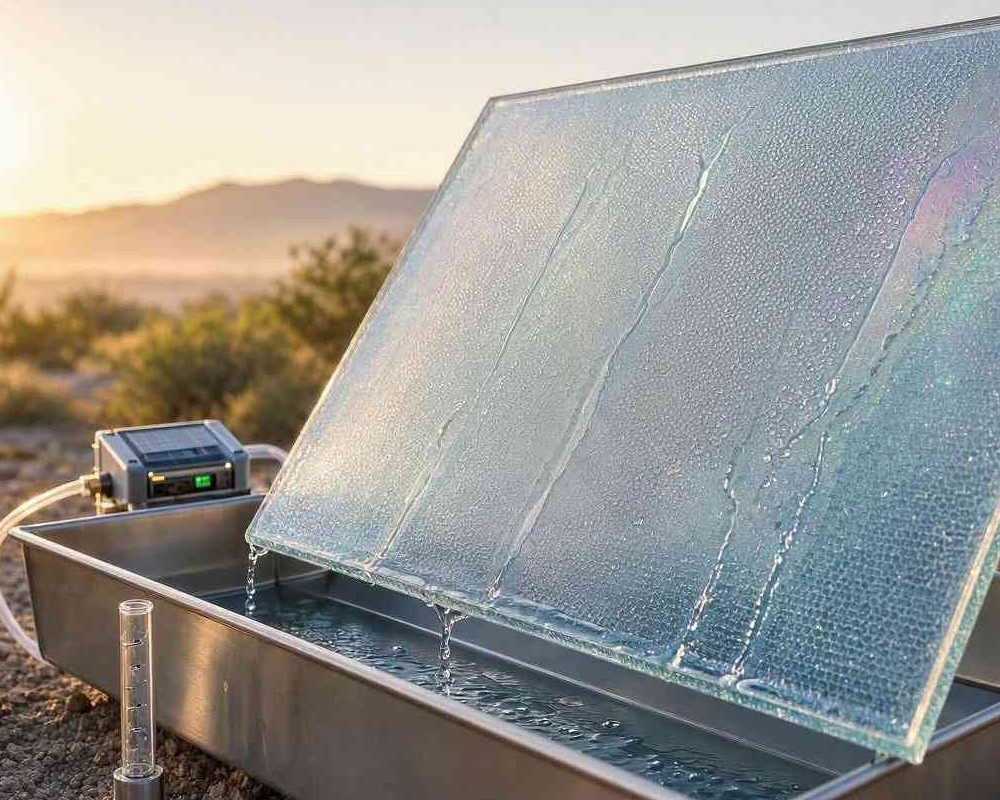
Cooling alone is not enough. Condensed droplets must leave the surface so that new water can form. A suitable coating controls how water interacts with the glass, helping droplets merge, move, and drain into a storage channel. Rapid droplet removal also prevents a continuous water film from reducing the surface’s cooling performance.
The Role of Artificial Intelligence
AI did not independently manufacture the glass. Instead, machine-learning and computational optimization tools helped researchers search through possible material combinations, layer thicknesses, and optical properties. Testing every configuration in a laboratory would require considerable time and expense. An algorithm can evaluate a large design space and identify promising structures for physical fabrication and validation.
Potential Benefits of Passive Water Collection
Traditional atmospheric water generators often cool air with compressors, which consume electricity. A passive glass surface could reduce that energy requirement by using natural heat radiation and gravity-driven drainage. Important potential advantages include:
- Lower operating energy than conventional refrigerated condensation systems
- Few moving components and potentially simpler maintenance
- Compatibility with roofs, panels, facades, and greenhouse structures
- Modular installation close to farms, homes, or industrial facilities
- Simultaneous cooling and moisture-management functions in some applications
Practical Limits and Engineering Challenges
Atmospheric water harvesting is not equally effective in every climate. Humid air contains more recoverable moisture, while dry conditions and a low dew point make condensation difficult. Clouds, dust, wind, and surrounding buildings can also influence radiative cooling. Actual water yield must therefore be measured across seasons rather than inferred from a single laboratory experiment.
Safety, Durability, and Scale
Collected water is not automatically safe to drink. Airborne particles, microorganisms, roof contaminants, and substances used in the collection system may enter the liquid. Potable applications require hygienic storage, filtration, disinfection, and regular water-quality testing.
The coating must also survive ultraviolet exposure, abrasion, temperature changes, and repeated wetting. Manufacturing cost will determine whether it can compete with fog nets, rainwater tanks, desalination, or powered atmospheric water generators. Researchers must demonstrate long service life without using materials that create environmental or recycling problems.
Why the Development Matters
The AI-designed coating shows how computational materials discovery can accelerate climate and water technologies. By combining optical engineering, surface science, and machine learning, researchers can optimize materials for several functions at once. The glass is not a universal answer to water scarcity, but it could become a useful component of localized supply systems where humidity, climate, and infrastructure make passive condensation practical.