

In recent years, there has been a significant advancement in the field of Artificial Intelligence (AI) and Augmented Reality (AR). These technologies have become increasingly popular and have the potential to enhance virtual experiences in various fields such as gaming, education, healthcare, and...
AI Developed a New Method of Extracting Hydrogen from Seawater
180
25.05.2026
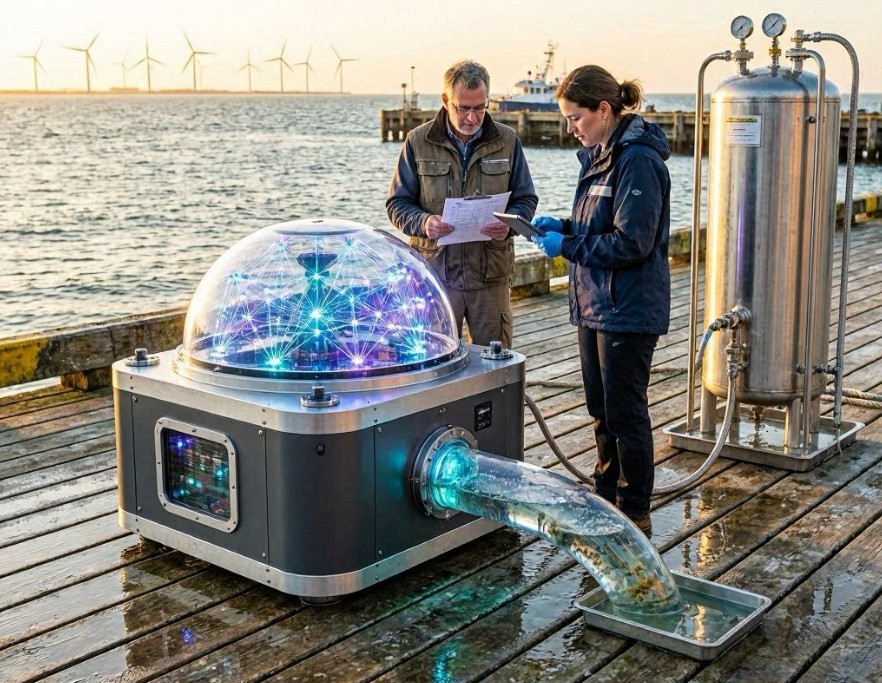
The challenge of hydrogen production today
Hydrogen is considered a key energy carrier for the future because it produces no carbon emissions when used as fuel. However, most hydrogen today is produced from natural gas through processes that still generate significant CO₂ emissions.
Water electrolysis is a cleaner alternative, but it typically requires purified freshwater and expensive catalysts, making large-scale deployment difficult.
Seawater, which is abundant, seems like an ideal resource, but its chemical complexity creates major technical challenges.
Why seawater is difficult to use directly
Seawater contains not only water molecules but also salts, minerals, and organic compounds. During electrolysis, these impurities can cause corrosion, reduce efficiency, and produce unwanted chemical byproducts like chlorine gas.
These issues have historically limited direct hydrogen production from seawater without extensive pre-treatment.
How AI approaches the problem
Artificial intelligence is now being used to explore thousands of possible material and reaction combinations that could make seawater electrolysis more efficient and stable.
Instead of relying on trial-and-error in laboratories, AI models simulate electrochemical reactions at scale and predict which catalysts and system designs are most promising.
Key data sources used by the system
- Databases of known catalysts and materials
- Electrochemical reaction simulations
- Corrosion and stability test results
- Previous hydrogen production experiments
What the AI-designed method changes
The newly developed approach focuses on improving selectivity and resistance to corrosion, allowing hydrogen to be extracted directly from seawater with fewer side reactions.
The system also optimizes electrode surfaces at the microscopic level, improving efficiency while reducing energy loss.
Main innovations introduced
- Selective catalyst coatings that reduce chlorine formation
- Corrosion-resistant electrode structures
- Optimized ion transport pathways
- Energy-efficient reaction configurations
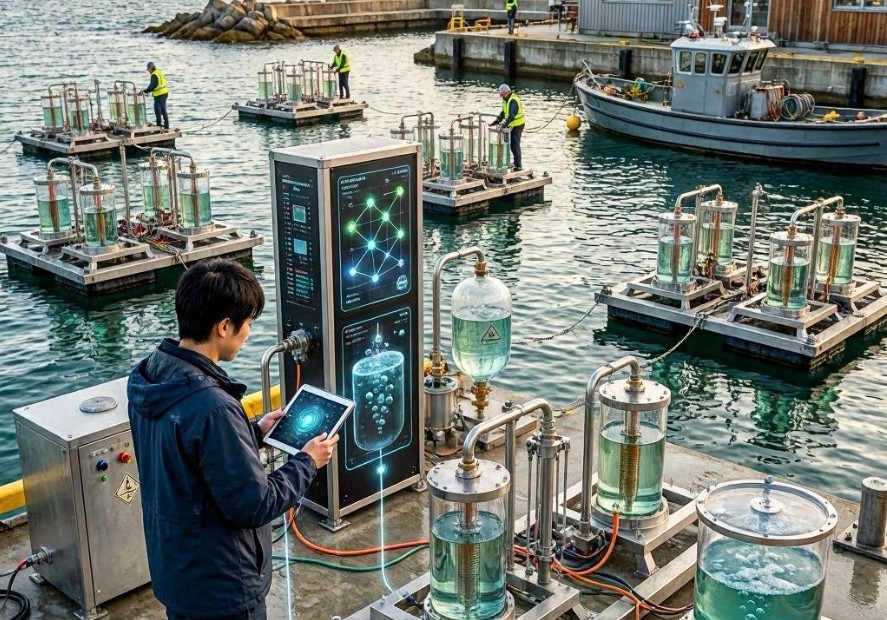
How machine learning accelerates discovery
Machine learning models evaluate millions of theoretical material combinations that would be impossible to test manually. They rank candidates based on predicted efficiency, durability, and cost.
This significantly shortens the development cycle for new energy technologies.
Development workflow
- Simulation of electrochemical environments
- Generation of candidate materials
- Predictive performance scoring
- Selection of top-performing designs
- Experimental validation in laboratories
Why hydrogen from seawater matters
If scalable, seawater-based hydrogen production could dramatically expand access to clean fuel, especially in coastal regions.
It would also reduce dependence on freshwater resources, which are increasingly under pressure in many parts of the world.
Advantages of the AI-driven approach
Key benefits
- Faster discovery of viable materials
- Reduced cost of experimentation
- Improved system efficiency
- Potential use of abundant seawater resources
Limitations and engineering challenges
Despite promising results, scaling the technology remains difficult. Laboratory success does not always translate to industrial environments where conditions are more variable and demanding.
Long-term stability of materials in real seawater conditions is still a key concern.
Future of AI in energy innovation
AI-driven material discovery is expected to play a major role in the transition to clean energy, enabling faster development of batteries, fuels, and catalytic systems.
Conclusion
Artificial intelligence is reshaping hydrogen research by enabling new methods of extracting fuel from seawater, potentially unlocking a more sustainable and scalable energy future.