
In recent years, there has been a significant advancement in the field of Artificial Intelligence (AI) and Augmented Reality (AR). These technologies have become increasingly popular and have the potential to enhance virtual experiences in various fields such as gaming, education, healthcare, and...
AI Developed a New Road Surface That Does Not Crack in Freezing Temperatures
152
12.06.2026
Why roads crack in winter
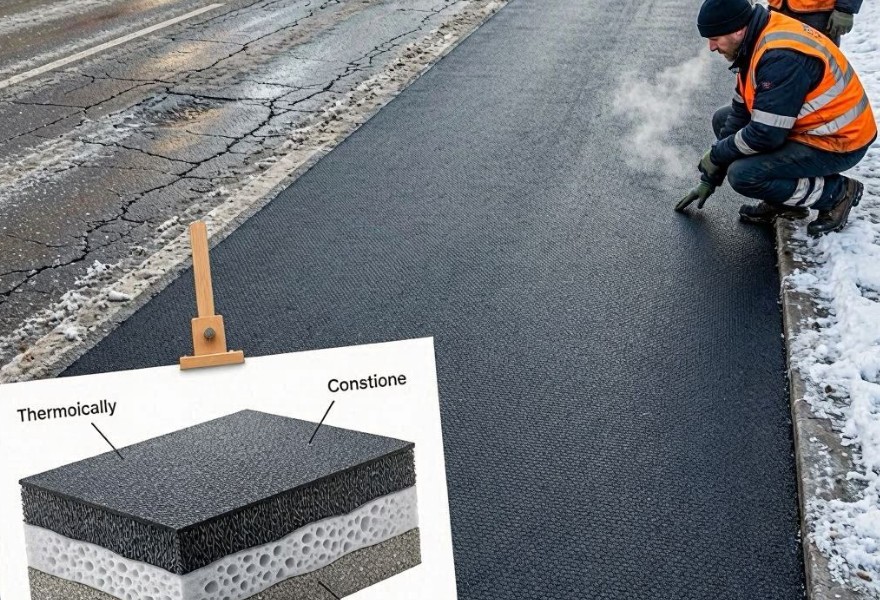
Road surfaces are constantly exposed to temperature changes, moisture, and mechanical stress. In cold climates, water seeps into microscopic cracks, freezes, and expands. This freeze–thaw cycle gradually widens damage and leads to potholes and structural failure.
Traditional asphalt mixtures reduce this problem using additives and engineering techniques, but they still degrade over repeated seasonal cycles.
This makes road durability in freezing conditions a long-standing infrastructure challenge.
How AI helps design better road materials
Artificial intelligence accelerates material discovery by analyzing thousands of possible asphalt compositions and predicting their performance under extreme environmental conditions.
Instead of relying only on physical testing, the system uses simulations and historical material data to identify mixtures that are more resistant to cracking.
Main data sources
- Laboratory tests of asphalt mixtures
- Historical road failure data
- Temperature and climate stress simulations
- Material composition databases
What makes the new road surface different
The AI-designed road surface is optimized at the molecular and structural level to better absorb stress and reduce water penetration. It focuses on flexibility, self-healing behavior, and improved binding between materials.
These improvements help the surface withstand repeated freezing and thawing cycles without structural breakdown.
Key innovations in material design
- Enhanced polymer binders for flexibility
- Micro-structured surfaces that reduce water infiltration
- Improved aggregate bonding strength
- Temperature-adaptive material response
How machine learning finds better asphalt mixtures
Machine learning models simulate how different material combinations behave under stress. They evaluate cracking probability, deformation resistance, and long-term durability.
The system iteratively refines candidate designs until it identifies mixtures that outperform traditional formulations.
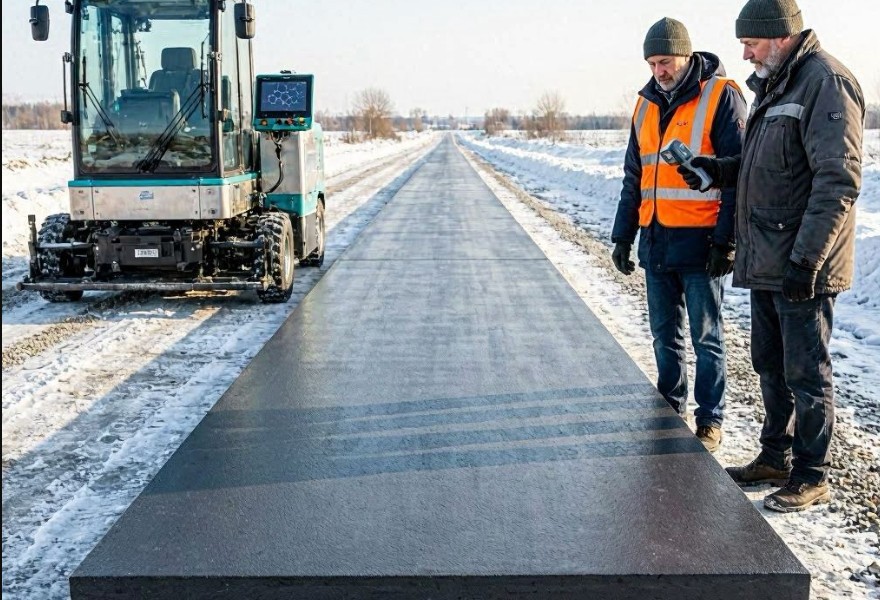
Design workflow
- Generation of candidate material compositions
- Simulation of freeze–thaw cycles
- Prediction of mechanical stress response
- Ranking of durability performance
- Selection of optimal formulations for testing
Why AI improves infrastructure materials
Traditional material development is slow and expensive because it relies heavily on physical experimentation. AI reduces this dependency by narrowing the search space and focusing laboratory testing on the most promising candidates.
This accelerates innovation and reduces development costs.
Benefits of AI-designed road surfaces
Main advantages
- Reduced cracking in freezing conditions
- Lower maintenance and repair costs
- Longer road lifespan
- Improved safety for drivers
Limitations and real-world challenges
Even advanced materials must be validated under real-world conditions, where traffic loads, weather variability, and construction quality can affect performance.
Scaling laboratory success to national infrastructure requires extensive field testing and regulatory approval.
Future of AI in civil engineering
Future systems may design fully adaptive infrastructure materials that respond dynamically to environmental changes, as well as integrate self-monitoring sensors embedded directly into road surfaces.
Conclusion
AI-driven material design is transforming civil engineering by enabling the creation of road surfaces that are significantly more resistant to freezing damage, improving durability and reducing maintenance costs.