
In recent years, there has been a significant advancement in the field of Artificial Intelligence (AI) and Augmented Reality (AR). These technologies have become increasingly popular and have the potential to enhance virtual experiences in various fields such as gaming, education, healthcare, and...
AI Developed a New Type of Battery From Recycled Smartphones
32
04.09.2026
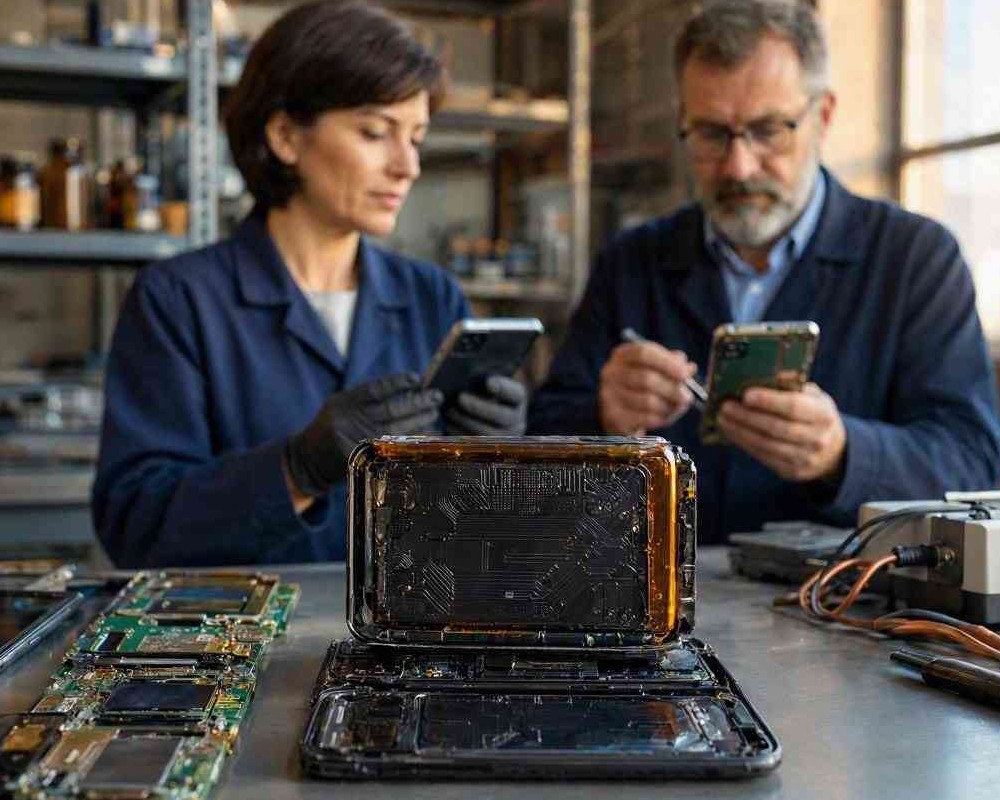
Artificial intelligence is changing more than software. It is increasingly being used to discover materials, optimize industrial processes, and solve engineering problems that would take researchers years to evaluate manually. One promising application is a new battery design created with the help of AI and manufactured using valuable materials recovered from discarded smartphones.
The development connects two urgent challenges: growing demand for energy storage and the rapid accumulation of electronic waste. Instead of treating old phones as disposable products, researchers can use them as concentrated sources of lithium, cobalt, nickel, copper, and graphite. AI helps determine how these recovered materials can be processed and combined to deliver reliable battery performance.
How Smartphones Become Battery Raw Materials
Recovering Valuable Components
A smartphone contains a complex mixture of metals, plastics, glass, and electronic components. Its battery and circuit boards are particularly valuable because they contain materials also required for electric vehicles, consumer electronics, and stationary energy storage.
During recycling, devices are collected, sorted, dismantled, and mechanically processed. Specialized hydrometallurgical or thermal methods can then separate useful elements from contaminated material. The recovered substances must be purified before they can return to battery production.
- Lithium can be reused in active electrode materials.
- Cobalt and nickel can support energy-dense cathode chemistry.
- Graphite may be refined for new anodes.
- Copper can return to current collectors and electrical connections.
Why Recycling Is Technically Difficult
Recycled feedstock is less predictable than newly mined material. Its purity, particle size, chemical composition, and previous degradation can vary between batches. Small differences may affect charging speed, capacity, safety, and service life. This variability is where AI-assisted analysis becomes especially useful.
What Artificial Intelligence Contributes
Faster Material Discovery
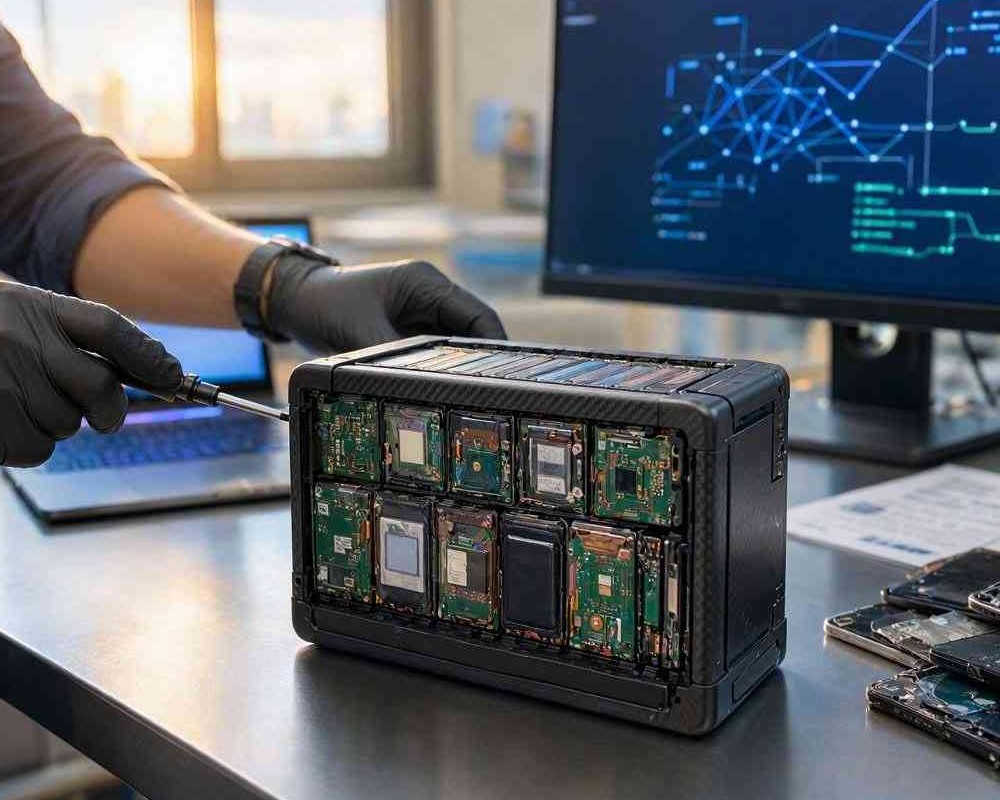
AI models can examine large datasets covering chemical structures, processing temperatures, electrode ratios, and laboratory test results. They identify relationships that may be difficult to detect through conventional experimentation. Researchers can then prioritize the most promising formulations rather than testing thousands of combinations individually.
The technology does not physically manufacture a battery or replace scientific validation. Instead, it acts as an advanced decision-making tool. Every AI-generated candidate must still undergo laboratory production, safety evaluation, repeated charge cycles, and independent performance testing.
Optimizing Recycled Material
Machine-learning systems can adjust a battery recipe according to the properties of each recycled batch. For example, a model may recommend changes to purification, particle treatment, binders, electrolytes, or electrode composition. This adaptive approach could make recovered smartphone materials more consistent and commercially useful.
Potential Environmental and Economic Benefits
Reusing materials from smartphones could reduce dependence on newly mined resources. Mining and refining battery metals require substantial energy and water, while poorly managed extraction can damage ecosystems and expose workers to unsafe conditions. Closed-loop recycling keeps existing resources in circulation and reduces the amount of electronic waste sent to landfills or informal processing sites.
The approach may also strengthen regional supply chains. Countries without large mineral reserves could recover strategic materials from local electronics. However, the final environmental benefit depends on collection rates, recycling efficiency, transport distances, energy sources, and the durability of the resulting battery.
What Must Happen Before Commercial Adoption
- Recycled materials must meet strict purity and safety standards.
- Battery performance must remain stable over many charging cycles.
- Recycling facilities need scalable and energy-efficient processes.
- Manufacturers require transparent data about material origin and quality.
- Independent testing must confirm environmental and economic claims.
AI-assisted batteries made from recycled smartphones offer a practical vision of circular technology: yesterday’s electronics becoming tomorrow’s energy-storage systems. The concept will require rigorous testing and industrial investment, but it demonstrates how artificial intelligence can help turn electronic waste into a valuable resource rather than a growing liability.