

In recent years, there has been a significant advancement in the field of Artificial Intelligence (AI) and Augmented Reality (AR). These technologies have become increasingly popular and have the potential to enhance virtual experiences in various fields such as gaming, education, healthcare, and...
AI Discovered Unknown Bach Manuscripts in Monastery Archives
206
19.05.2026
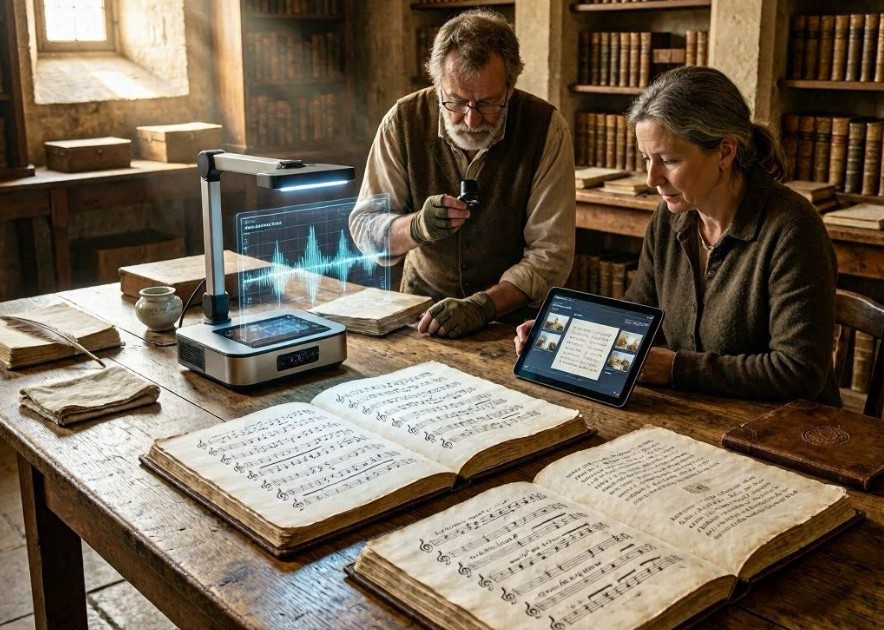
The mystery of lost Baroque manuscripts
Many works from the Baroque period were never formally cataloged or were lost due to wars, fires, and deterioration of archival materials. As a result, music historians continue to search monastery libraries and private collections for unknown compositions.
Johann Sebastian Bach, despite being one of the most studied composers in Western music, still has disputed and fragmentary works that occasionally resurface in archives.
The possibility that unknown manuscripts could still exist has driven both traditional scholarship and modern computational analysis.
How AI scans historical archives
Artificial intelligence systems are now used to digitize and analyze vast collections of handwritten musical scores stored in monasteries and libraries. These systems do not simply read text but interpret musical notation, handwriting style, and structural patterns.
The goal is to identify works that may belong to known composers based on stylistic fingerprints.
Sources analyzed by the system
- Scanned manuscript pages
- Handwritten musical notation
- Historical catalog records
- Ink and paper aging patterns
How the algorithm identifies Bach’s style
The AI model is trained on authenticated Bach compositions, learning recurring structural and harmonic patterns. These include specific chord progressions, counterpoint techniques, and melodic phrasing.
It then compares unknown manuscripts against this stylistic signature to estimate attribution probability.
Key musical features analyzed
- Counterpoint density and structure
- Harmonic progression patterns
- Motif repetition and variation
- Rhythmic phrasing characteristics
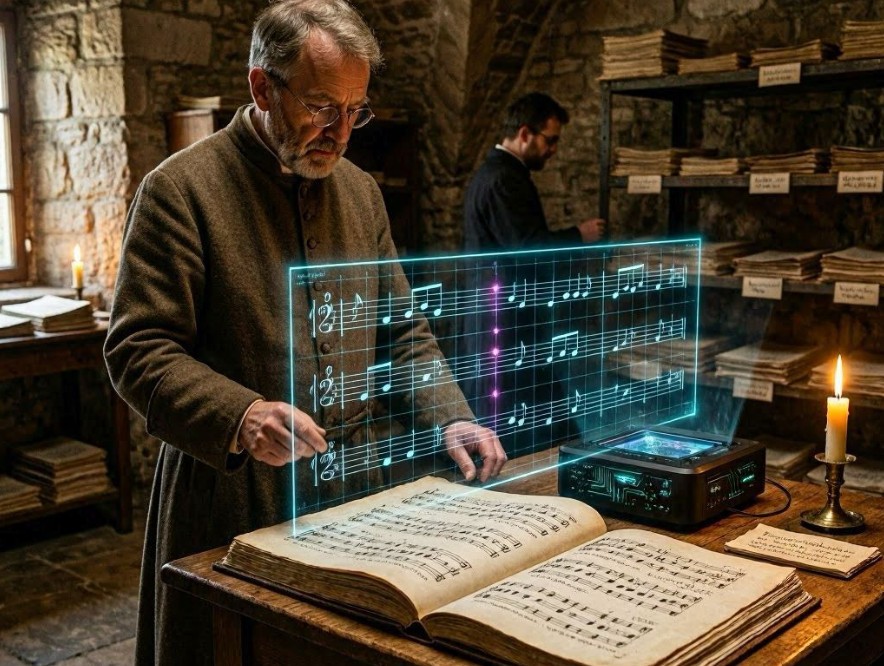
The discovery process in monastery archives
In digitized monastery collections, the AI flagged several manuscripts that did not match known cataloged works but showed strong stylistic alignment with Bach’s compositional patterns.
These documents had previously been misattributed or remained uncategorized due to unclear provenance.
Stages of identification
- Digitization of archival materials
- Optical recognition of musical notation
- Stylistic pattern analysis
- Cross-comparison with verified Bach works
- Attribution scoring and verification
Why AI is valuable in musicology
Traditional musicological research relies heavily on expert analysis, which is time-consuming and limited by human capacity. AI accelerates this process by scanning thousands of pages quickly and consistently.
It also helps detect subtle stylistic similarities that may be overlooked in manual review.
Limitations of automated attribution
Despite its power, AI cannot definitively prove authorship. Stylistic similarity does not guarantee that a piece was composed by Bach, as students and contemporaries often imitated his style.
Final confirmation requires expert evaluation, historical context, and sometimes physical manuscript verification.
Impact on classical music research
The discovery of potential unknown works can reshape understanding of Bach’s creative output and influence how Baroque music is interpreted and performed.
It also demonstrates how digital humanities are transforming traditional academic disciplines.
Conclusion
AI is becoming an essential tool in archival research, offering new possibilities for uncovering hidden works and expanding knowledge of historical composers like Bach.