

In recent years, there has been a significant advancement in the field of Artificial Intelligence (AI) and Augmented Reality (AR). These technologies have become increasingly popular and have the potential to enhance virtual experiences in various fields such as gaming, education, healthcare, and...
AI Helps Archivists Digitize and Catalogue Historical Documents
7
09.10.2026
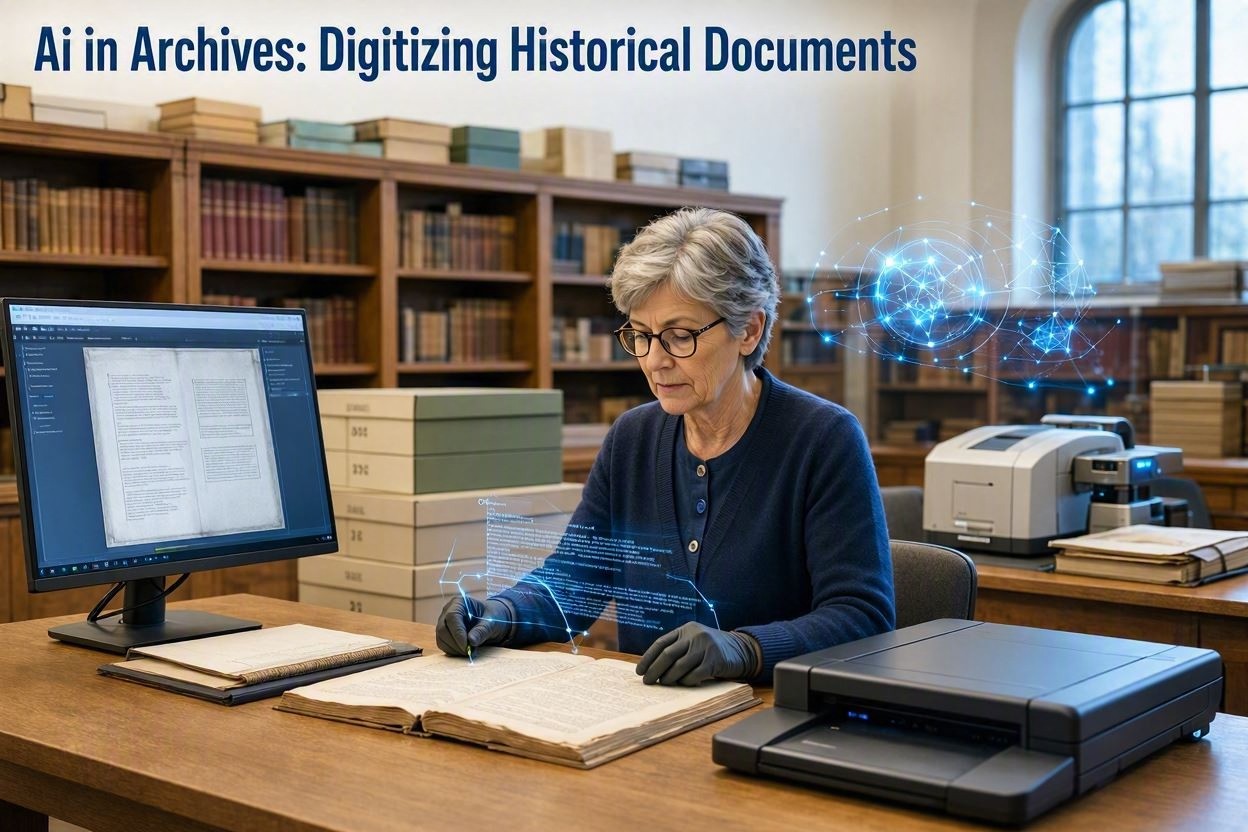
Archives hold letters, maps, ledgers, court records, photographs, newspapers, and institutional files that explain how societies lived, worked, governed, and remembered. For decades, archivists have protected these materials while facing a difficult problem: the volume of records is far greater than the time and staff available to describe them in detail. Artificial intelligence is changing that balance. Used carefully, AI helps archivists digitize historical documents faster, extract searchable information, and create richer catalogues without replacing professional judgment.
Why Archives Need AI-Assisted Digitization
Traditional digitization is labor-intensive. A document must be scanned or photographed, checked for image quality, named, stored, described, and linked to catalogue records. If it contains text, someone may need to transcribe it before researchers can search it. When collections include millions of pages, manual processing alone can take years.
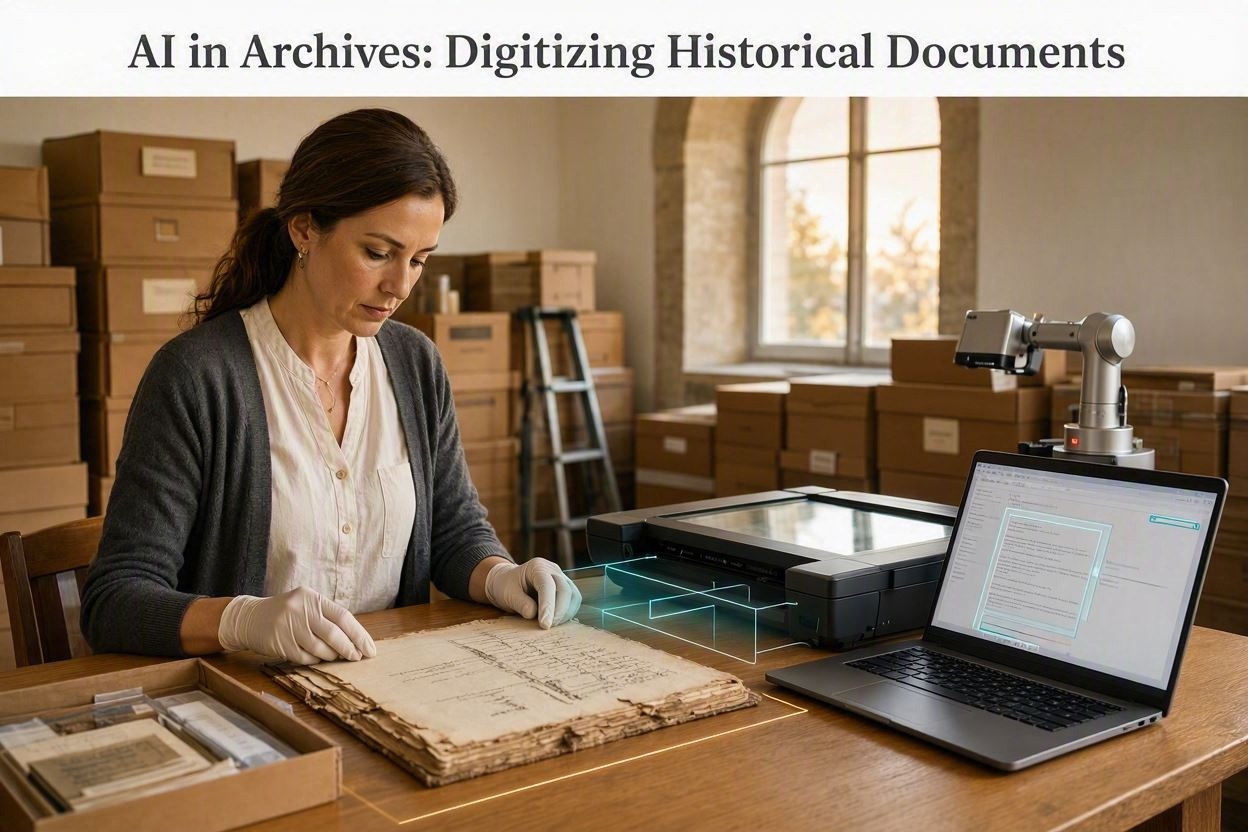
AI supports this work by automating repetitive tasks and highlighting patterns that would be difficult to detect at scale. It can identify document types, recognize handwriting, suggest dates and names, group related records, and flag damaged or duplicated images. The result is not instant perfection, but a more efficient workflow in which archivists spend less time on mechanical sorting and more time on interpretation, context, and preservation decisions.
Key AI Technologies Used in Archives
Optical Character Recognition and Handwritten Text Recognition
Optical character recognition, or OCR, converts printed text in scanned images into machine-readable text. Modern OCR tools perform well on clean printed pages, including books, newspapers, and typed correspondence. For older materials, AI-based models can adapt to unusual fonts, degraded ink, stains, and irregular layouts.
Handwritten text recognition, often called HTR, is even more important for historical collections. Diaries, census forms, field notes, and personal letters are frequently handwritten. AI models trained on sample pages can learn the writing style of a clerk, author, or institution and produce searchable transcriptions. Human review remains essential, especially for names, places, abbreviations, and archaic spelling.
Metadata Extraction and Entity Recognition
Good cataloguing depends on metadata: titles, dates, creators, locations, subjects, languages, formats, and relationships between records. AI can scan transcribed text and suggest metadata fields automatically. Named entity recognition can identify people, organizations, geographic locations, and events mentioned in a document.
For example, a collection of immigration records may contain thousands of names, birthplaces, ship names, and arrival dates. AI can extract these entities, connect similar spellings, and help archivists create structured indexes. Researchers then gain faster access to relevant material, while archivists can review and correct suggestions before publication.
Image Enhancement and Quality Control
AI also improves the visual side of digitization. Image processing models can detect blurred scans, skewed pages, cropped margins, glare, or low contrast. Some tools can enhance faded ink or separate text from background stains. These features help institutions maintain consistent digitization standards and reduce the risk of publishing unusable images.
Benefits for Researchers and the Public
AI-assisted archives make historical documents more discoverable. Instead of browsing box-level descriptions, users can search full text, filter by date or place, and find names hidden deep inside large collections. This expands access for historians, genealogists, students, journalists, and community researchers who may never visit the physical archive.
- Faster discovery of relevant documents across large collections
- Improved access to handwritten and previously unindexed records
- Better multilingual search when translation tools are integrated
- More consistent metadata for digital preservation and citation
- Reduced backlog for institutions with limited staffing
Challenges Archivists Must Manage
Accuracy, Bias, and Context
AI systems can misread damaged pages, unfamiliar handwriting, nonstandard grammar, or marginalized names that appear rarely in training data. They may also reflect biases present in historical records or modern datasets. An incorrect transcription can mislead researchers; a poor metadata suggestion can hide a document from search results.
That is why archivists treat AI output as a draft, not as an authority. Professional review, confidence scoring, sampling, and transparent correction processes are necessary. Archives should document which tools were used, what level of accuracy was achieved, and where users should be cautious.
Ethical Access and Sensitive Records
Digitization can expose personal information at a scale that was impossible in a reading room. AI may surface names, addresses, medical details, legal records, or information about vulnerable communities. Archivists must balance openness with privacy, cultural sensitivity, donor agreements, and legal restrictions.
Responsible institutions build review policies before releasing AI-processed collections. In some cases, access may be limited, redacted, delayed, or shaped in consultation with descendant communities.
Best Practices for AI-Ready Archival Workflows
- Start with clear goals, such as full-text search, name indexing, or image quality control.
- Create high-quality scans, because AI accuracy depends heavily on source images.
- Use representative training samples for handwriting and specialized collections.
- Keep humans in the loop for validation, especially on public metadata.
- Preserve original files, AI outputs, corrections, and documentation together.
The Future of Historical Document Cataloguing
AI will not replace archivists because archives are not merely data stores. They require appraisal, provenance, ethical judgment, historical knowledge, and care for physical materials. However, AI can become a powerful assistant that reduces repetitive labor and opens collections that were once effectively invisible.
The most successful archival projects will combine machine speed with human expertise. When archivists guide AI systems, audit their results, and explain their limitations, digitized historical documents become more searchable, more inclusive, and more useful for future generations.