In recent years, there has been a significant advancement in the field of Artificial Intelligence (AI) and Augmented Reality (AR). These technologies have become increasingly popular and have the potential to enhance virtual experiences in various fields such as gaming, education, healthcare, and...
AI Helps Speech Therapists Track Children's Progress Between Sessions
31
05.11.2026

Speech therapy does not stop when a child leaves the clinic, school, or teletherapy room. The real challenge often happens between sessions, when families try to practice target sounds, language exercises, fluency strategies, or social communication skills at home. Artificial intelligence is beginning to make this gap easier to manage by giving speech-language pathologists clearer insight into a child’s progress outside scheduled appointments.
AI tools cannot replace a qualified speech therapist, but they can support more consistent monitoring, better home practice, and earlier recognition of patterns that may otherwise be missed. When used responsibly, AI can help therapists make decisions based on richer information rather than relying only on parent reports or short weekly observations.
Why Progress Between Sessions Matters
Children build communication skills through repetition, feedback, and real-life use. A child may produce a sound correctly during a session but struggle with the same sound at home, in school, or during conversation. Similarly, a child working on vocabulary or sentence structure may perform well in structured tasks but need more support in spontaneous speech.
Tracking what happens between sessions helps therapists answer important clinical questions:
- Is the child practicing regularly?
- Which words, sounds, or situations remain difficult?
- Does performance improve in natural conversation?
- Are parents using the recommended strategies correctly?
- Should the therapy plan be adjusted sooner?
Without ongoing information, therapists may lose valuable time. AI-supported tracking can make progress more visible and measurable.
How AI Supports Speech Therapy Monitoring
Speech Recognition and Sound Analysis
Modern AI can analyze short audio recordings and identify speech patterns such as sound substitutions, omissions, repetitions, and pronunciation accuracy. For articulation therapy, this can help show whether a child is improving on sounds like “r,” “s,” “th,” or “k” during home practice.
For example, a child may record ten practice words each day. The AI system can flag which attempts were close to the target and which need review. The therapist can then look at trends over time instead of judging progress from one isolated session.
Language Practice Data
AI can also support children working on vocabulary, grammar, narrative skills, and comprehension. Some platforms can track how often a child uses target words, answers questions correctly, or builds longer sentences during guided activities. This information helps the therapist understand whether the child is generalizing new language skills beyond direct instruction.
Fluency and Voice Tracking
For children who stutter or have voice goals, AI tools may help monitor speaking rate, pauses, repetitions, volume, or vocal strain. This can be especially useful because fluency and voice quality often change depending on stress, environment, fatigue, and communication demands.
Benefits for Speech Therapists
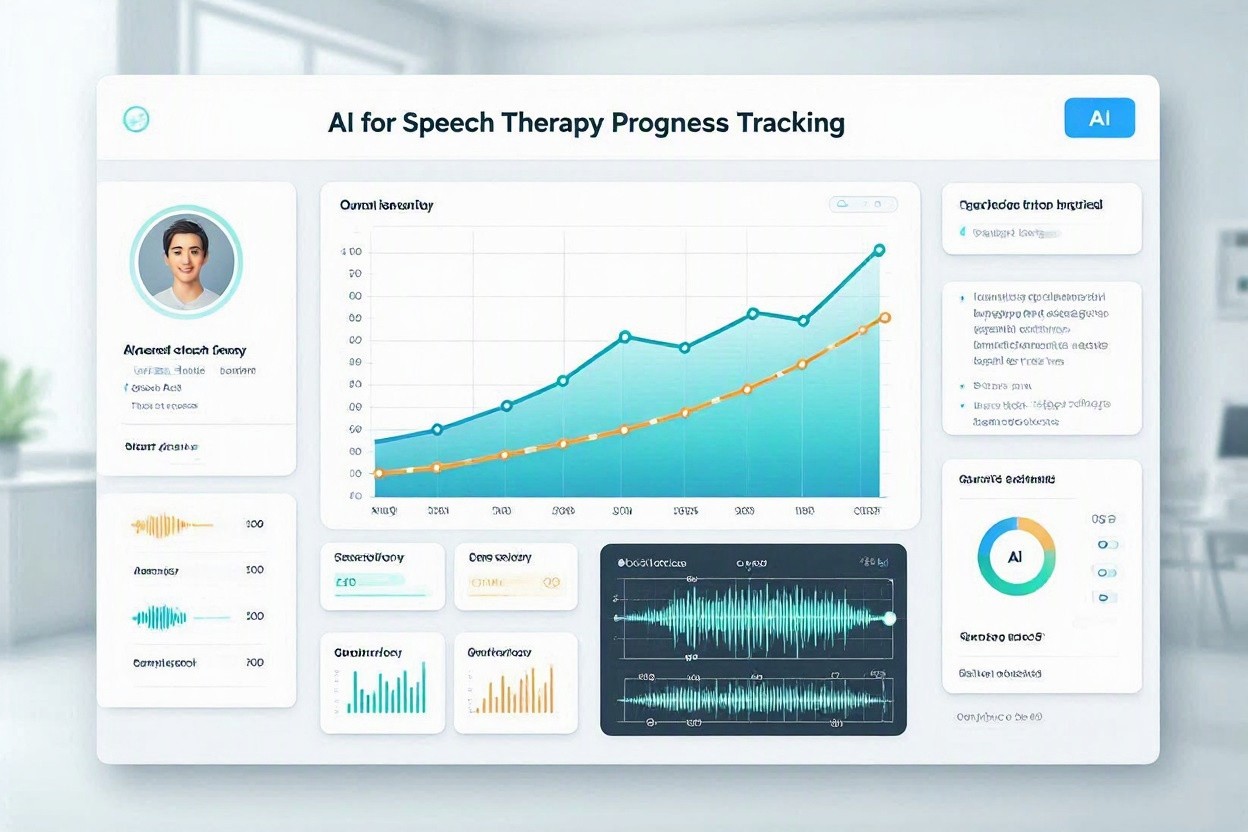
AI gives therapists access to practical data between visits. Instead of spending part of each session trying to reconstruct what happened during the week, clinicians can review summaries, recordings, and progress charts before the appointment.
This can help therapists:
- Adjust goals based on current performance.
- Identify skills that need more practice.
- Spot plateaus or regression earlier.
- Use session time more efficiently.
- Provide more specific coaching to parents.
AI can also reduce administrative burden. Automated notes, progress summaries, and practice logs may save time, allowing therapists to focus more on clinical judgment and individualized treatment.
Benefits for Families and Children
More Consistent Home Practice
Families often want to help but may not know whether practice is being done correctly. AI-guided tools can offer immediate feedback, reminders, and simple practice routines. This makes home exercises feel less confusing and more achievable.
Motivation Through Visible Progress
Children are often more motivated when they can see improvement. Progress badges, charts, or recordings can show that their effort is making a difference. For some children, this turns speech practice from a chore into a more engaging routine.
Better Communication With the Therapist
Parents can share data and recordings with the therapist instead of relying on memory. This creates a more accurate picture of the child’s communication in everyday settings and helps families feel more involved in the therapy process.
Important Limits and Ethical Considerations
AI in speech therapy must be used carefully. Children’s speech data is sensitive, and privacy should be a top priority. Families and clinicians should choose tools that explain how recordings are stored, who can access them, and whether data is used for training algorithms.
Accuracy is another concern. AI may misunderstand children with severe speech sound disorders, accents, bilingual language patterns, or motor speech difficulties. For that reason, AI results should be treated as supportive information, not a final diagnosis or clinical decision.
The therapist’s expertise remains essential. A speech-language pathologist understands the child’s history, developmental level, emotional needs, cultural background, and therapy goals. AI can highlight patterns, but the clinician interprets those patterns and decides what to do next.
The Future of AI-Assisted Speech Therapy
As AI tools become more advanced, they may help create more personalized therapy plans. A system could recommend practice words based on a child’s recent errors, suggest easier or harder activities, or alert the therapist when progress slows. Integrated teletherapy platforms may also combine video, audio, home assignments, and progress reports in one secure place.
The most effective future will not be AI replacing speech therapists. It will be AI helping therapists see more, respond faster, and support families more effectively between sessions.
Conclusion
AI is becoming a valuable partner in tracking children’s speech and language progress outside therapy sessions. By analyzing practice, identifying trends, and improving communication between therapists and families, AI can make treatment more responsive and consistent. Used ethically and guided by professional judgment, it can help children receive better support every day, not only during appointment time.