

In recent years, there has been a significant advancement in the field of Artificial Intelligence (AI) and Augmented Reality (AR). These technologies have become increasingly popular and have the potential to enhance virtual experiences in various fields such as gaming, education, healthcare, and...
AI Learned to Determine a Fish's Age from Its Scales More Accurately Than Biologists
217
26.04.2026
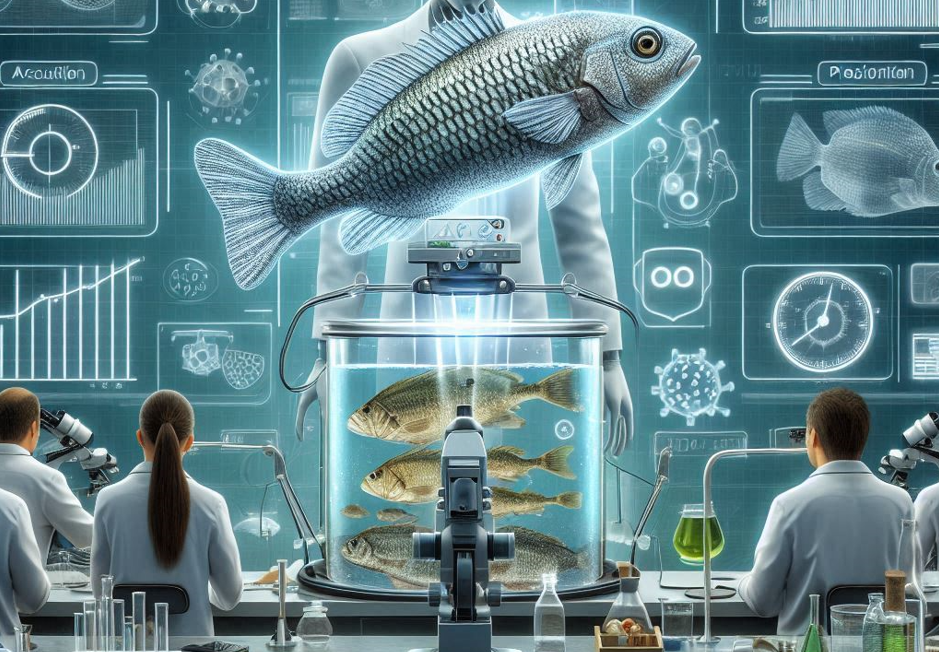
Determining the age of a fish has long been a critical task in marine biology. Accurate age estimation helps scientists understand population dynamics, growth rates, and ecosystem health. Traditionally, biologists analyze growth rings on fish scales, similar to counting rings on a tree. However, this process requires expertise and can be prone to human error. A new AI system is changing this paradigm by achieving higher accuracy and consistency than human experts.
Traditional Methods of Age Estimation
Fish scales contain growth rings known as annuli, which form as the fish grows. By examining these rings under a microscope, biologists estimate the age of the fish.
Limitations of Manual Analysis
- Subjectivity in interpreting ring patterns
- Difficulty distinguishing closely spaced rings
- Variability between experts
These challenges often lead to inconsistent results, especially for older fish with complex scale patterns.
The AI Approach
The new system uses deep learning to analyze high-resolution images of fish scales. It identifies patterns that may be too subtle for human observers.
Core Technologies
- Convolutional neural networks for image analysis
- Pattern recognition algorithms
- Large annotated datasets for training
The AI learns from thousands of labeled samples, enabling it to detect nuanced features associated with age.
How the System Works
The process begins with capturing detailed images of fish scales. These images are then processed by the AI model.
Analysis Steps
- Image enhancement and normalization
- Detection of growth rings
- Feature extraction and classification
- Age estimation output
The system provides not only an age estimate but also a confidence score, indicating the reliability of the prediction.

Accuracy and Advantages
Studies have shown that the AI system outperforms human experts in many cases. It delivers consistent results and reduces the influence of subjective interpretation.
Key Benefits
- Higher accuracy in age estimation
- Faster processing of large datasets
- Standardized results across studies
Implications for Marine Science
Accurate age data is essential for managing fish populations and ensuring sustainable fishing practices. The AI system enables researchers to analyze larger datasets more efficiently.
This leads to better-informed decisions regarding conservation and resource management.
Challenges
Despite its success, the system must be trained on diverse datasets to ensure accuracy across different species and environments.
Potential Limitations
- Data availability for rare species
- Variability in scale quality
- Dependence on image resolution
The Future of AI in Biology
The success of this system highlights the growing role of AI in biological research. Similar approaches may be applied to other areas, such as plant growth analysis or wildlife monitoring.
By combining human expertise with machine precision, scientists can achieve new levels of understanding and accuracy.
This innovation not only improves age estimation but also sets a precedent for the integration of artificial intelligence in scientific discovery.