

In recent years, there has been a significant advancement in the field of Artificial Intelligence (AI) and Augmented Reality (AR). These technologies have become increasingly popular and have the potential to enhance virtual experiences in various fields such as gaming, education, healthcare, and...
AI Learned to Identify a Car’s Make From Its Engine Sound
19
07.09.2026
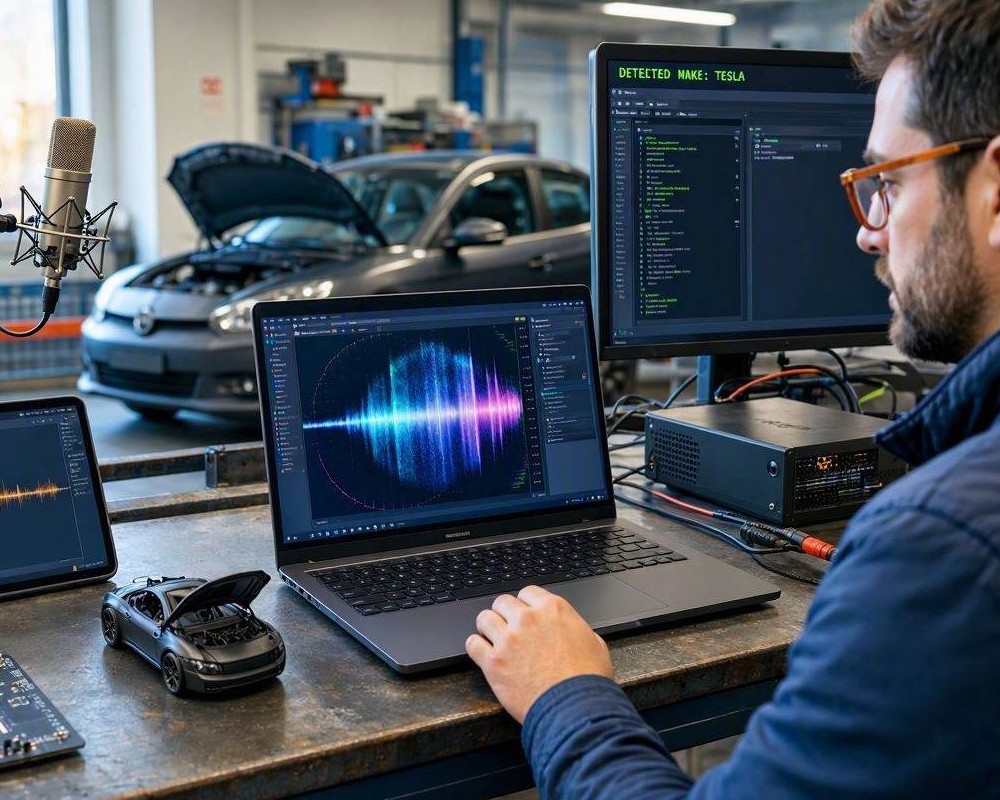
Artificial intelligence can recognize faces, interpret speech, and detect objects in photographs. Now, researchers are teaching machine learning systems to identify a car’s make by listening to its engine. Instead of examining badges, body shapes, or license plates, the technology analyzes an acoustic signature created by combustion, exhaust flow, mechanical movement, and vibration.
The idea is based on a simple observation: vehicles do not all sound alike. Engine configuration, displacement, firing order, turbocharging, exhaust design, and manufacturing tolerances influence the noise produced by a running car. A trained AI model can find subtle patterns within these sounds, including differences that may be difficult for a human listener to notice consistently.
How AI Recognizes a Car by Sound
An engine-sound recognition system begins with a collection of labeled audio recordings. Each sample is associated with information such as the vehicle manufacturer, model, engine type, operating speed, and recording conditions. The dataset may include cars idling, accelerating, cruising, or starting from cold. Greater variety helps the system work beyond controlled laboratory environments.
Turning Audio Into Data
Raw sound waves are usually converted into spectrograms, which visually represent frequency, intensity, and time. These images reveal recurring harmonics, pulses, and transient noises. Machine learning models, including convolutional neural networks and audio transformers, can then learn which combinations of features are associated with particular manufacturers.
For example, the model might detect the characteristic rhythm of a specific cylinder layout or frequency patterns influenced by an automaker’s exhaust tuning. It does not “hear” a brand in the human sense. Instead, it calculates the probability that an acoustic sample belongs to one of the makes represented in its training data.
Training and Testing the Model
Developers divide recordings into training, validation, and test sets. The model learns from the training samples, while the remaining data measures how accurately it handles unfamiliar recordings. Robust testing should include different microphones, distances, weather conditions, traffic noise, and examples of several vehicles running simultaneously.
Potential Uses of Engine-Sound Recognition
Audio-based vehicle identification could complement cameras, radar, and other sensors. Because microphones are relatively inexpensive, the technology may be useful where visual identification is unreliable or impossible.
- Traffic monitoring: Roadside systems could estimate the types of vehicles passing through an area, even in darkness or poor visibility.
- Automotive diagnostics: AI could compare current engine noise with normal recordings to flag unusual mechanical behavior.
- Security: Acoustic recognition might help detect an unexpected vehicle near restricted infrastructure.
- Smart mobility research: Aggregated sound data could provide insights into traffic composition and urban noise.
More Than Brand Identification
The same technology may eventually distinguish engine families, fuel types, or operating conditions. It could also identify signs of misfiring, worn bearings, belt problems, or exhaust leaks. Diagnostic applications may offer greater practical value than naming a manufacturer because early detection could reduce repair costs and prevent breakdowns.

Why Real-World Accuracy Is Difficult
Recognizing a car make from sound is not as straightforward as a controlled demonstration may suggest. Aftermarket exhaust systems can significantly alter a vehicle’s acoustic profile. Engine wear, maintenance quality, road surfaces, surrounding buildings, and microphone placement also affect recordings. Different manufacturers may use the same engine platform, creating additional ambiguity.
Electric Vehicles Change the Challenge
Electric vehicles produce less powertrain noise than combustion-powered cars, and their sounds are dominated by tire contact, airflow, reduction gears, and artificial pedestrian alerts. An AI system may still classify some models, but it would need different training features. As electric mobility expands, acoustic identification will increasingly focus on complete vehicle soundscapes rather than engine notes alone.
Privacy and Responsible Deployment
Vehicle audio can be captured passively, so deployment requires clear privacy safeguards. Recordings may unintentionally contain conversations or other identifiable sounds. Responsible systems should process data locally where possible, retain only necessary acoustic features, and follow applicable surveillance and data-protection rules. AI engine recognition is a promising sensor technology, but its value will depend on transparent use, representative datasets, and honest reporting of accuracy limits.