
In recent years, there has been a significant advancement in the field of Artificial Intelligence (AI) and Augmented Reality (AR). These technologies have become increasingly popular and have the potential to enhance virtual experiences in various fields such as gaming, education, healthcare, and...
AI Learned to Verify Signature Authenticity by Pen Pressure
212
06.06.2026
Why signature verification is a challenging problem
Signatures are widely used for identity verification in banking, legal documents, and official transactions. However, handwritten signatures vary naturally even for the same person due to mood, speed, surface, and writing instrument.
At the same time, skilled forgeries can closely imitate visual appearance, making visual inspection alone unreliable.
This creates a need for systems that analyze deeper behavioral characteristics of handwriting rather than just static shape.
What pen pressure reveals about identity
Pen pressure refers to the force applied by a writer during handwriting. It creates subtle patterns in stroke thickness, ink density, and writing rhythm that are difficult to consciously replicate.
Even when a signature looks visually similar, the underlying pressure dynamics often remain distinct between genuine writing and imitation.
Key behavioral signals
- Variation in pressure across strokes
- Acceleration and deceleration patterns
- Pen lift frequency and timing
- Consistency of writing force distribution
How the AI system captures pen pressure
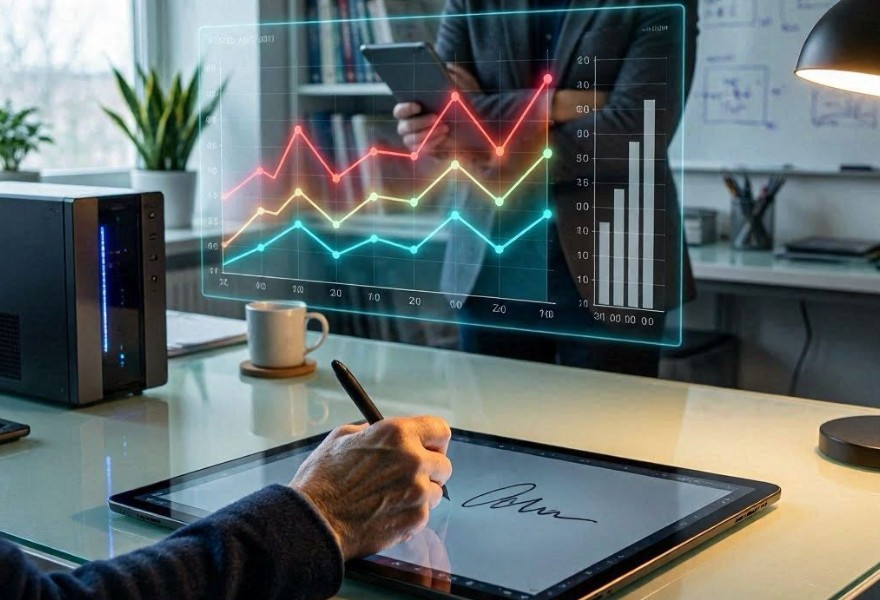
The system uses digital tablets, smart pens, or pressure-sensitive writing surfaces to record detailed biometric data during signature input.
This data is captured as a time series rather than a simple image, allowing analysis of how the signature was produced, not just what it looks like.
Data collected during signing
- Pressure intensity per stroke
- Stroke direction and velocity
- Temporal sequencing of movements
- Hand tremor and micro-variations
How machine learning verifies authenticity
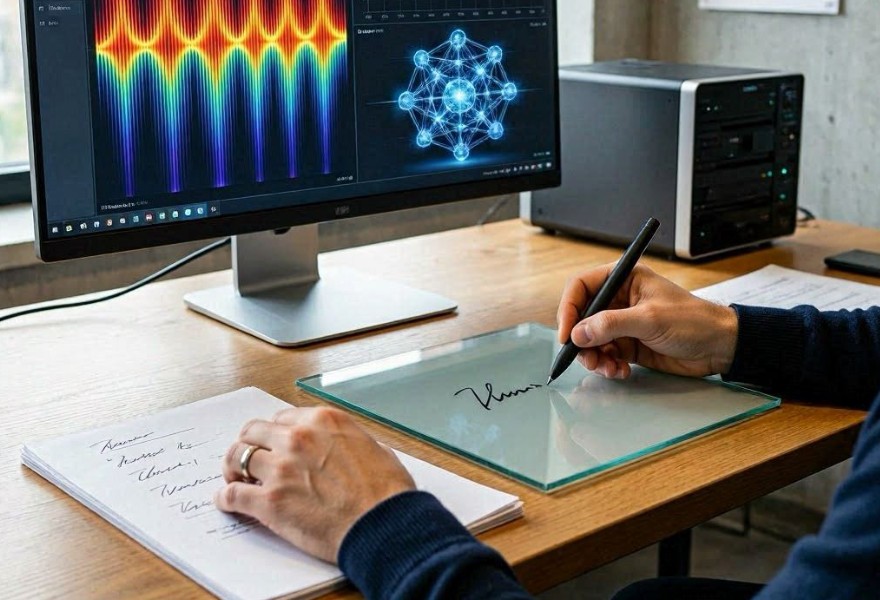
A neural network is trained on multiple genuine signatures from the same individual to learn their unique signing behavior. It then compares new samples against this learned behavioral profile.
The system evaluates both visual similarity and dynamic writing patterns to determine authenticity.
Verification workflow
- Acquisition of dynamic signature data
- Feature extraction from pressure and motion signals
- Comparison with stored signature profiles
- Anomaly detection for inconsistent patterns
- Final authenticity scoring
Why pressure-based analysis improves security
Visual forgeries can replicate shape but struggle to reproduce natural writing dynamics. Pen pressure patterns are difficult to consciously control, especially under observation or time constraints.
This makes behavioral biometrics a stronger layer of authentication than image-based comparison alone.
Applications of AI signature verification
Main use cases
- Banking and financial authorization
- Legal document verification
- Secure digital identity systems
- Fraud detection in contracts and forms
Limitations of the approach
Signature dynamics can change over time due to injury, aging, or changes in writing tools. This may require periodic re-enrollment of user profiles.
Additionally, systems based on specialized hardware are less effective when only static images of signatures are available.
Future of behavioral authentication
Future identity systems may combine pen pressure with other biometric signals such as voice, touch behavior, and gait analysis to create multi-layered authentication frameworks.
Conclusion
AI-driven signature verification using pen pressure represents a shift from visual imitation checks to behavioral authentication, significantly improving resistance to forgery and fraud.