

In recent years, there has been a significant advancement in the field of Artificial Intelligence (AI) and Augmented Reality (AR). These technologies have become increasingly popular and have the potential to enhance virtual experiences in various fields such as gaming, education, healthcare, and...
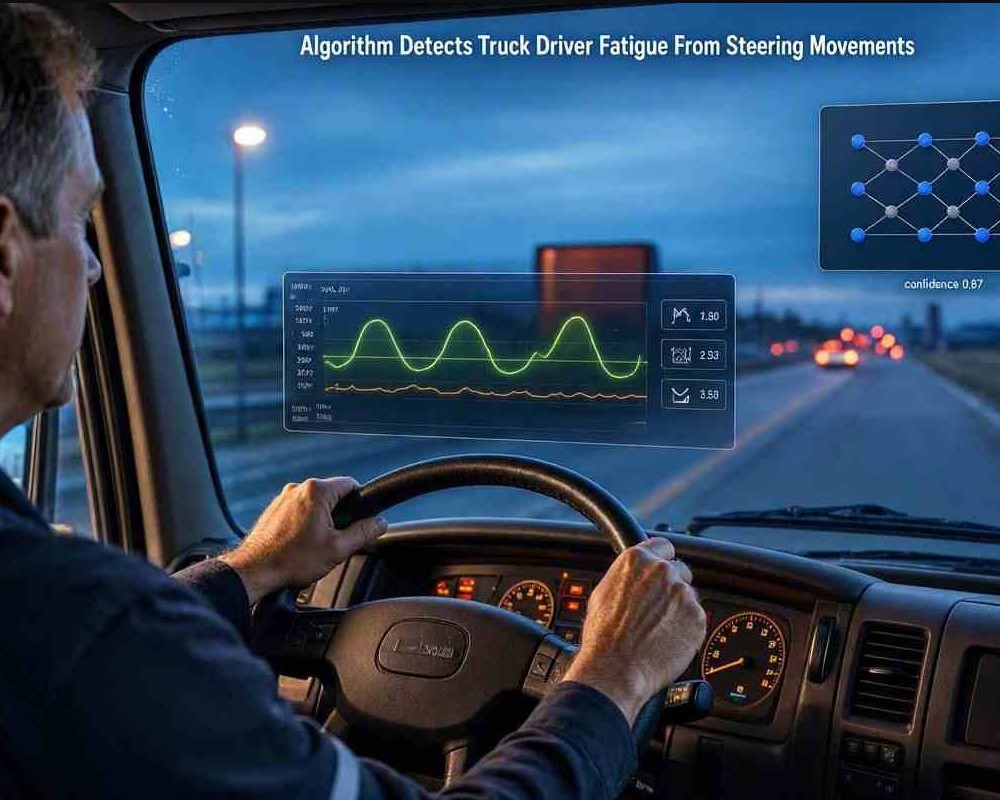
Algorithm Detects Truck Driver Fatigue From Steering Movements
3
09.09.2026

Driver fatigue remains one of the most difficult road safety risks for trucking companies to manage. Long shifts, monotonous highways, irregular sleep schedules, and overnight driving can reduce alertness before a driver recognizes the danger. A fatigue detection algorithm based on steering movements offers a practical way to identify this decline without requiring wearable sensors or constant video monitoring.
The technology analyzes how a truck driver handles the steering wheel over time. Small changes in correction frequency, steering smoothness, response timing, and lane-position control can indicate reduced concentration. By recognizing these patterns early, an onboard system can warn the driver or notify fleet safety personnel before fatigue contributes to a collision.
How Steering Behavior Reveals Driver Fatigue
An alert driver continuously makes subtle steering adjustments. These movements help compensate for road curvature, wind, vehicle dynamics, and minor deviations within the lane. Although they may be barely noticeable, they create a measurable pattern.
As fatigue develops, steering behavior often becomes less consistent. A tired driver may allow the truck to drift for longer periods and then make a larger corrective movement. Reaction intervals can increase, while precise adjustments may be replaced by abrupt inputs. An algorithm can compare these signals with a baseline representing attentive driving.
Key Steering Signals Used by the Algorithm
- Frequency and size of steering corrections
- Changes in steering wheel angle
- Speed and smoothness of corrective movements
- Periods with unusually little steering activity
- Repeated patterns associated with lane drifting
These indicators are evaluated together rather than treated as isolated proof of drowsiness. A single sharp turn could result from a pothole or strong crosswind. Persistent changes across multiple signals provide a more reliable basis for a warning.
How the Detection Process Works
Collecting and Preparing Vehicle Data
The system can obtain steering information from sensors already integrated into a modern truck. Data may be combined with speed, lane position, trip duration, time of day, and road conditions. Filtering removes irrelevant vibration and helps distinguish intentional maneuvers from irregular corrections linked to declining attention.
Recognizing Fatigue-Related Patterns
Machine learning models can be trained with driving data labeled according to alertness levels. During operation, the algorithm examines recent steering behavior and calculates a fatigue risk score. If that score crosses a defined threshold, the system can activate an audible warning, seat vibration, dashboard message, or fleet alert.
Personalization can improve performance. Drivers differ in posture, steering style, experience, and preferred lane position. A system that gradually learns an individual driver’s normal behavior may detect meaningful changes while reducing unnecessary alarms.
Benefits for Truck Drivers and Fleet Operators
Steering-based fatigue monitoring has several operational advantages. It can function continuously without asking the driver to wear equipment or complete repeated alertness tests. Unlike camera-only systems, it does not depend on a clear view of the face, which may be affected by sunglasses, darkness, head position, or cab lighting.
- Earlier intervention: Warnings can encourage a driver to stop before drowsiness becomes critical.
- Nonintrusive monitoring: Analysis occurs through ordinary vehicle controls.
- Fleet-level insight: Aggregated data can reveal risky routes, schedules, or shift patterns.
- Safety support: Objective alerts complement driver training and fatigue management policies.
Limitations and Responsible Implementation
Steering analysis is not a complete solution. Rough pavement, high winds, heavy loads, road construction, and vehicle faults can influence steering behavior. The algorithm should therefore use contextual data and, where appropriate, work alongside lane-monitoring or driver-facing sensors.
Warnings Must Lead to Safe Action
A fatigue alert should never encourage a driver to continue simply because the system has not issued another warning. Fleets need clear procedures that allow drivers to take a safe break without pressure to meet unrealistic delivery targets. Collected data must also be protected, used transparently, and separated from unfair disciplinary practices.
A Promising Tool for Safer Trucking
An algorithm that detects truck driver fatigue from steering movements transforms routine vehicle data into an early safety signal. Its greatest value lies in supporting human judgment, not replacing it. When combined with realistic schedules, adequate rest, driver education, and responsible fleet policies, steering-based monitoring can help reduce fatigue-related risk and make long-distance trucking safer.