

In recent years, there has been a significant advancement in the field of Artificial Intelligence (AI) and Augmented Reality (AR). These technologies have become increasingly popular and have the potential to enhance virtual experiences in various fields such as gaming, education, healthcare, and...
An Algorithm Finds Weak Points in Legal Contracts Within Seconds
183
24.05.2026

Why legal contracts are difficult to analyze manually
Legal contracts are dense, structured documents filled with specialized terminology, cross-references, and conditional clauses. Even experienced lawyers can take hours or days to review a complex agreement in detail.
The challenge is not only reading the text, but understanding how individual clauses interact and where hidden risks may appear across the document.
This complexity creates opportunities for oversight, especially in high-volume legal environments such as corporate transactions or procurement.
How the algorithm processes legal documents
The system uses natural language processing to break contracts into structured components. Each clause is extracted, classified, and linked to related sections within the document.
Instead of reading linearly, the algorithm builds a relational map of obligations, exceptions, penalties, and dependencies.
Key processing steps
- Document segmentation into clauses and sections
- Identification of legal entities and obligations
- Extraction of conditional statements
- Mapping cross-references between clauses
What “weak points” mean in a legal context
Weak points are not necessarily errors, but provisions that may introduce risk, ambiguity, or imbalance between parties. These can include unclear wording, missing definitions, or clauses that disproportionately favor one side.
The algorithm evaluates both legal consistency and practical enforceability of contract terms.
Types of vulnerabilities detected
- Ambiguous or undefined terminology
- Conflicting clauses within the contract
- Unbalanced liability provisions
- Missing or incomplete obligations
How the AI identifies risks quickly
The system compares contract language against large datasets of previously analyzed agreements and known legal outcomes. It learns patterns associated with disputes, litigation risks, and contractual failures.
By encoding legal language into structured representations, the algorithm can evaluate risk in seconds rather than hours.
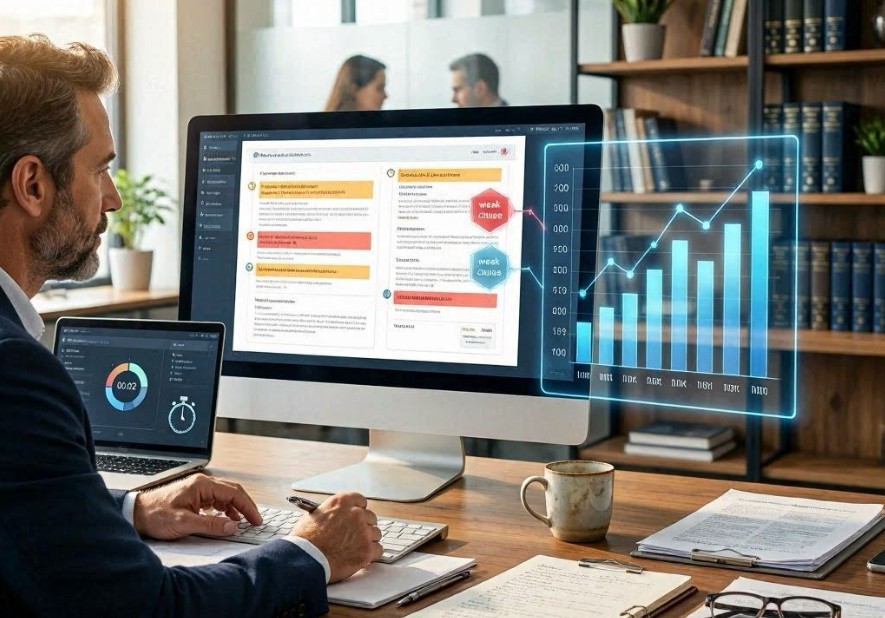
Analysis workflow
- Text normalization and parsing
- Legal clause classification
- Risk pattern matching
- Conflict detection across sections
- Generation of risk summary report
Role of machine learning in legal analysis
Machine learning models are trained on vast corpora of contracts and annotated legal disputes. This allows the system to recognize subtle patterns that may indicate future problems.
Over time, feedback from legal experts refines the model’s accuracy and reduces false positives.
Benefits of automated contract analysis
Key advantages
- Rapid review of complex documents
- Improved detection of hidden risks
- Reduced workload for legal professionals
- Greater consistency in contract evaluation
Limitations of the technology
Despite its speed, the algorithm cannot fully replace human legal judgment. Interpretation of intent, negotiation context, and jurisdiction-specific nuances still require expert oversight.
Additionally, poorly structured or highly unconventional contracts may reduce analysis accuracy.
Future of AI in legal practice
In the future, AI systems may become standard tools in law firms, integrated directly into contract drafting and negotiation platforms to provide real-time risk feedback.
Conclusion
AI-powered contract analysis transforms legal review from a slow manual process into a fast, data-driven assessment, helping identify weak points and improve contractual safety.