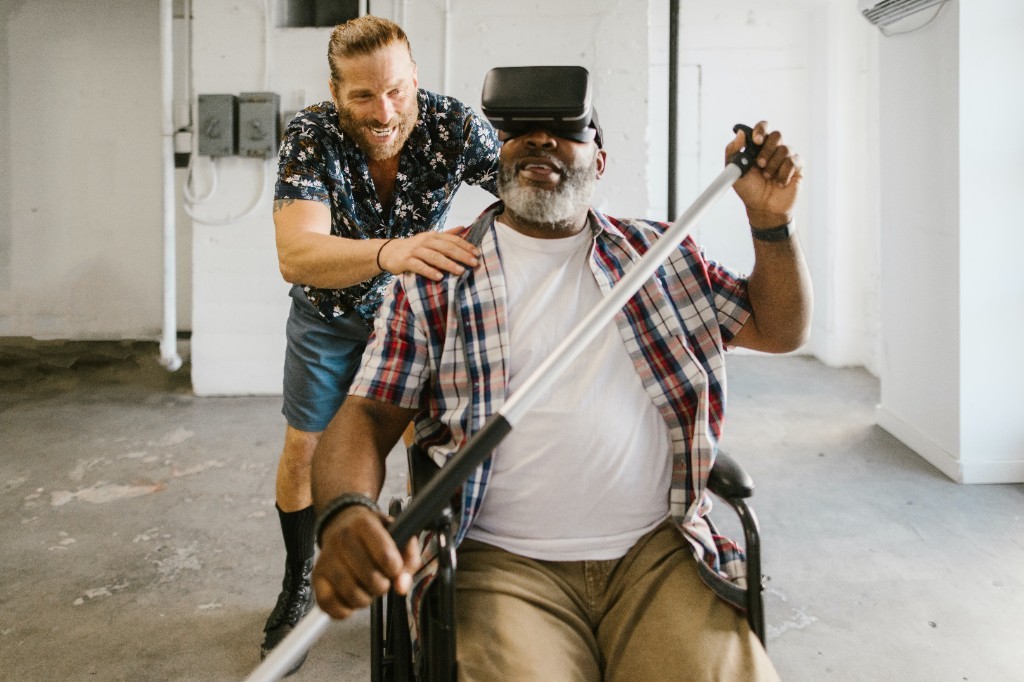
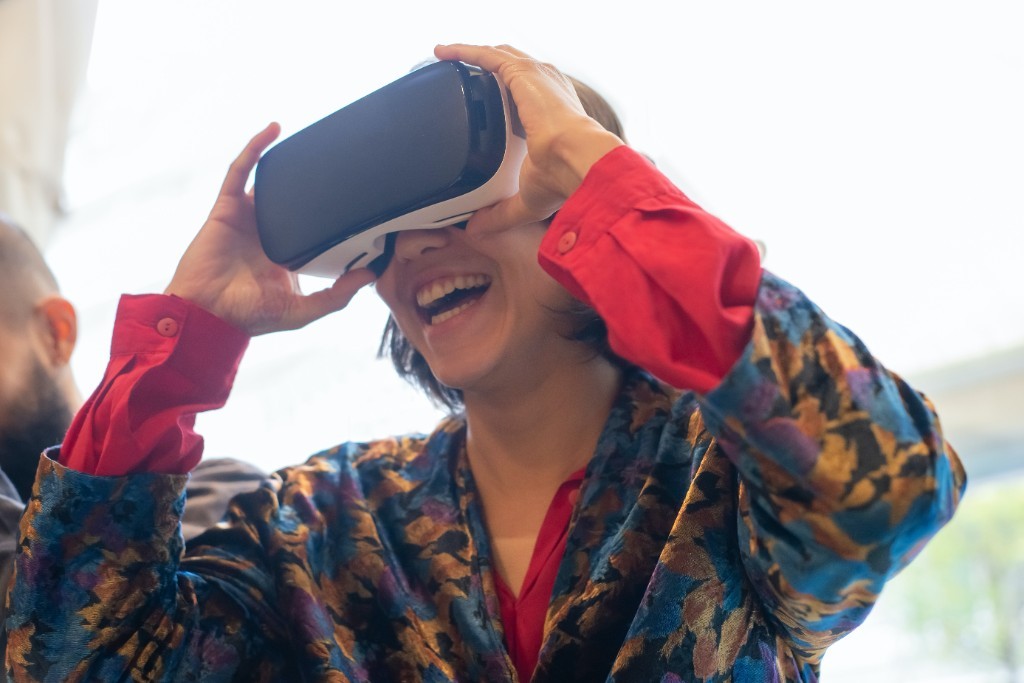
In recent years, there has been a significant advancement in the field of Artificial Intelligence (AI) and Augmented Reality (AR). These technologies have become increasingly popular and have the potential to enhance virtual experiences in various fields such as gaming, education, healthcare, and...
An Algorithm Helps Blind People Navigate Unfamiliar Buildings
157
11.07.2026
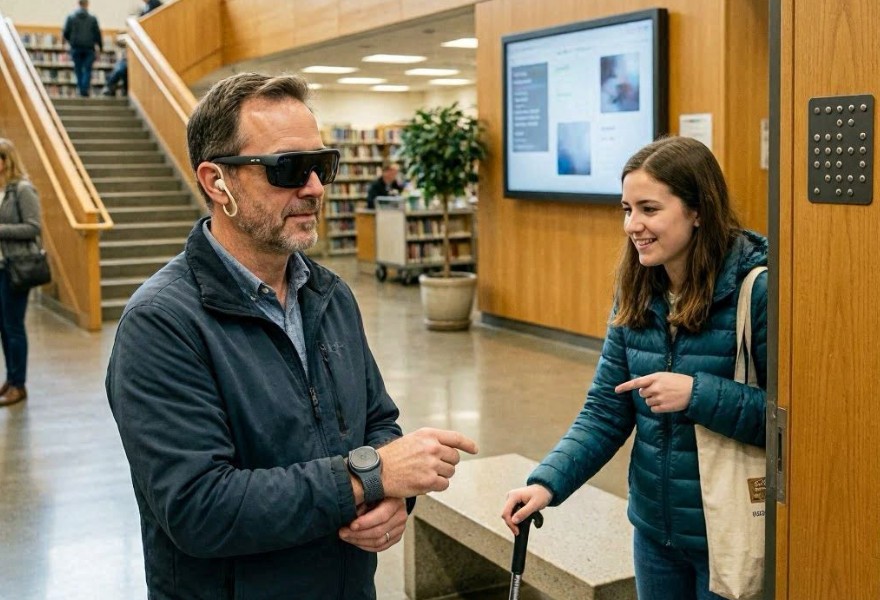
For individuals who are blind or visually impaired, the world is often structured around familiarity. We learn the routes we take every day—the path to the kitchen, the steps to the office, or the familiar layout of a local grocery store. However, entering an unfamiliar building—a large corporate office, a sprawling airport, or a labyrinthine university campus—presents a daunting challenge. Traditionally, this has required the assistance of sighted guides or the laborious process of learning a new space from scratch. Today, that narrative is changing rapidly. Advanced navigation algorithms, powered by computer vision and sensor fusion, are now providing the blind with the autonomy to explore and navigate unknown environments with unprecedented confidence.
This technological leap is not just about mapping; it is about "semantic understanding." The algorithm doesn't just know that there is a wall; it knows that the space contains a door, a set of stairs, or an elevator, and it communicates this information in real-time to the user.
The Digital Eye: Computer Vision and Spatial Mapping
The core of this navigation technology is a sophisticated algorithm that processes real-time video feed from a smartphone camera or a set of wearable glasses. This information is interpreted through a process known as Simultaneous Localization and Mapping (SLAM).
How the Algorithm Sees the World
The system performs several critical tasks concurrently to build a mental map for the user:
- Obstacle Detection: The algorithm identifies both permanent structures and transient objects—like a chair left in a hallway or a cleaning cart—and calculates the user's distance from them.
- Pathfinding: Using a digital representation of the building's floor plan, the AI calculates the most efficient route from the current location to the desired destination, continuously recalculating if the user deviates from the path.
- Object Recognition: The algorithm provides semantic context, such as identifying a sign that reads "Restroom," "Exit," or "Reception," which is crucial for navigating complex interior spaces.
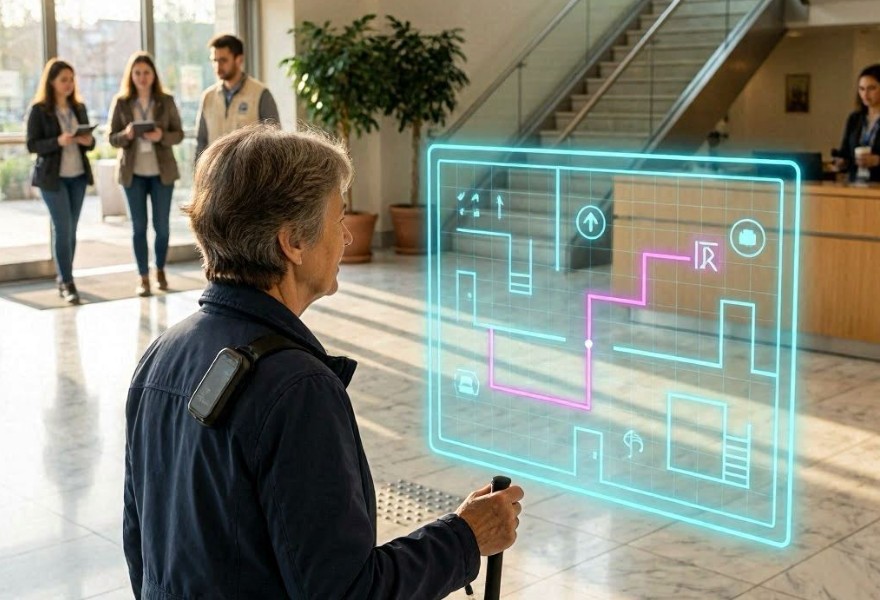
Bridging the Sensory Gap
Data is useless if it cannot be communicated effectively. The true brilliance of these systems lies in how they translate complex spatial data into intuitive, non-visual feedback for the user.
Haptic and Auditory Feedback
The software utilizes a combination of sensory channels to guide the user safely:
- Spatial Audio: Using bone-conduction headphones, the AI creates 3D sound cues. A "ping" that sounds like it is coming from the left indicates that the user needs to turn left, while a "thrum" might warn of an obstacle directly ahead.
- Haptic Alerts: Smartphones or wearable devices provide vibration pulses. A rhythmic vibration can signify "keep walking," while a sharp, continuous pulse indicates an immediate hazard.
- Voice Guidance: For complex decision points—such as a four-way intersection in a hallway—the AI provides clear, concise natural language instructions: "Take the second door on your right."
The Impact of Autonomy
The implications of this technology go far beyond simple convenience; they touch upon fundamental issues of dignity and independence. When a blind individual can walk into an airport and find their gate without needing to ask for help, it fundamentally changes their perception of their own capability.
Scalability and Accessibility
Because these algorithms often run on standard smartphones, the barrier to entry is remarkably low. As building managers begin to upload digital floor plans into public databases, these navigation algorithms become even more accurate, pulling from the building’s own architectural blueprints to guide the user with centimeter-level precision. This creates a feedback loop where public infrastructure becomes "digitally accessible" by default.
Challenges and the Path Forward
Despite the promise of this technology, challenges remain. Navigating in environments with high levels of ambient noise can interfere with auditory cues, and maintaining battery life during prolonged use is a constant engineering hurdle. Furthermore, the algorithms must be robust enough to handle crowded spaces where people are moving in unpredictable patterns.
As deep learning continues to improve, the next generation of these navigation tools will likely include "anticipatory modeling"—where the algorithm learns the typical flow of people in a building and suggests paths that are not just the shortest, but the least congested, further increasing safety for the user.
Conclusion
The integration of navigation algorithms into the daily lives of the blind is a hallmark of how technology can serve human needs. By turning the chaotic, unfamiliar visual world into a predictable, manageable digital space, we are opening doors that have been closed for far too long. As we continue to refine these systems, we move toward a future where "unfamiliarity" is no longer a barrier, and where the freedom of movement is a reality for everyone, regardless of their visual acuity.