In recent years, there has been a significant advancement in the field of Artificial Intelligence (AI) and Augmented Reality (AR). These technologies have become increasingly popular and have the potential to enhance virtual experiences in various fields such as gaming, education, healthcare, and...
An Algorithm Restores Lost Mosaics from Partial Fragments
204
05.06.2026
Why mosaic restoration is a complex historical problem
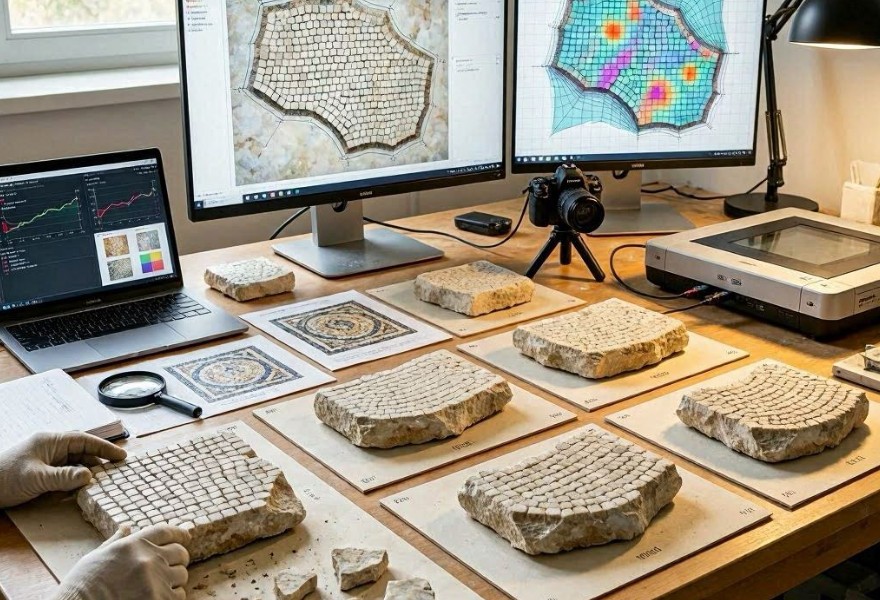
Mosaics are often discovered in a fragmented state due to centuries of decay, earthquakes, looting, or environmental damage. In many cases, only a fraction of the original artwork survives, scattered across excavation sites or museum collections.
Restoring these works requires not only reassembling physical fragments but also reconstructing missing sections that may no longer exist at all.
Traditional restoration depends heavily on expert interpretation, which can be slow and uncertain when large portions are missing.
How the algorithm approaches mosaic reconstruction
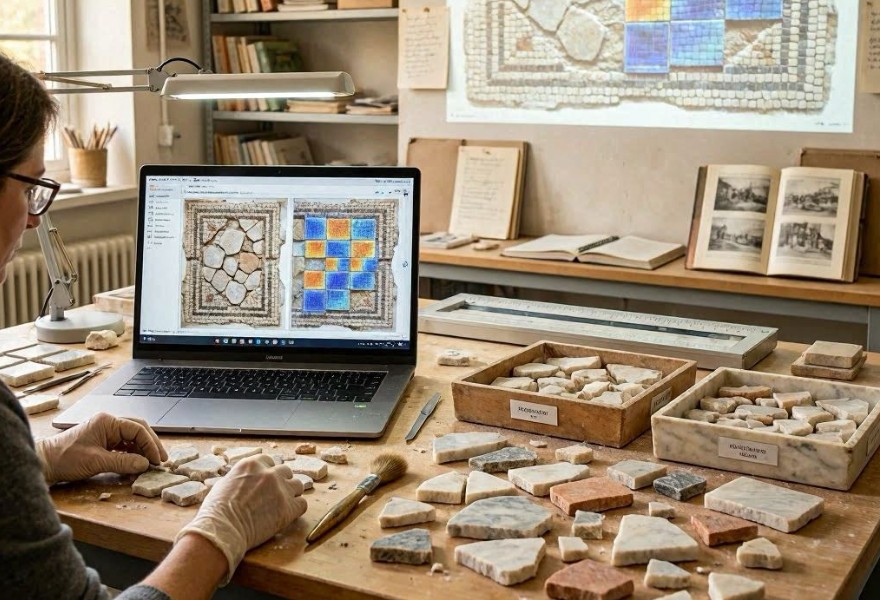
The system uses artificial intelligence to analyze surviving fragments and predict how missing sections should look based on geometric patterns, color distribution, and historical artistic styles.
Instead of treating each fragment independently, the algorithm builds a global model of the entire mosaic composition.
Main data inputs
- High-resolution images of mosaic fragments
- 3D scans of fragment surfaces
- Historical records of similar mosaics
- Artistic style databases from specific regions and periods
How fragment matching works
The first stage of reconstruction involves identifying which fragments likely belong together. The system analyzes edge shapes, tile alignment, pigment continuity, and material composition.
It then groups fragments into clusters that represent potential sections of the original mosaic.
Matching criteria
- Geometric edge compatibility
- Color and pigment continuity
- Tile size and orientation consistency
- Surface wear patterns alignment
How missing areas are reconstructed
Once fragments are assembled into partial structures, the algorithm predicts missing regions using generative models trained on complete mosaics from the same historical context.
These models infer probable patterns, motifs, and color schemes consistent with the original artistic style.
Reconstruction workflow
- Assembly of verified fragment clusters
- Detection of missing spatial regions
- Style-based pattern inference
- Generative completion of missing sections
- Validation against historical references
Role of machine learning in artistic reconstruction
Machine learning models learn from thousands of documented mosaics, capturing stylistic rules such as symmetry, repetition, and thematic composition typical of specific civilizations.
This allows the system to generate plausible reconstructions even when large portions of the original artwork are missing.
Why AI improves restoration accuracy
Human restoration is often constrained by subjective interpretation and incomplete visual memory of ancient styles. AI systems, in contrast, can compare fragments against vast datasets and identify subtle statistical patterns that guide reconstruction.
This leads to more consistent and evidence-based restorations.
Applications in archaeology and cultural preservation
Main uses
- Reconstruction of ancient Roman and Byzantine mosaics
- Digital preservation of fragile artifacts
- Virtual museum exhibitions
- Assistance in archaeological documentation
Limitations of algorithmic restoration
Despite advanced modeling, reconstructed sections remain probabilistic interpretations rather than definitive originals. Missing historical context or unknown artistic variations can introduce uncertainty.
Therefore, final restorations still require expert validation by archaeologists and art historians.
Future of digital restoration technology
Future systems may integrate 3D immersive visualization, material physics simulation, and cross-site archaeological data to create even more accurate reconstructions of lost artworks.
Conclusion
AI-powered mosaic restoration transforms fragmented archaeological remains into coherent visual narratives, helping preserve and reconstruct cultural heritage that would otherwise remain incomplete.