

In recent years, there has been a significant advancement in the field of Artificial Intelligence (AI) and Augmented Reality (AR). These technologies have become increasingly popular and have the potential to enhance virtual experiences in various fields such as gaming, education, healthcare, and...
How a Program Helps Children With Autism Recognize Emotions
18
28.08.2026
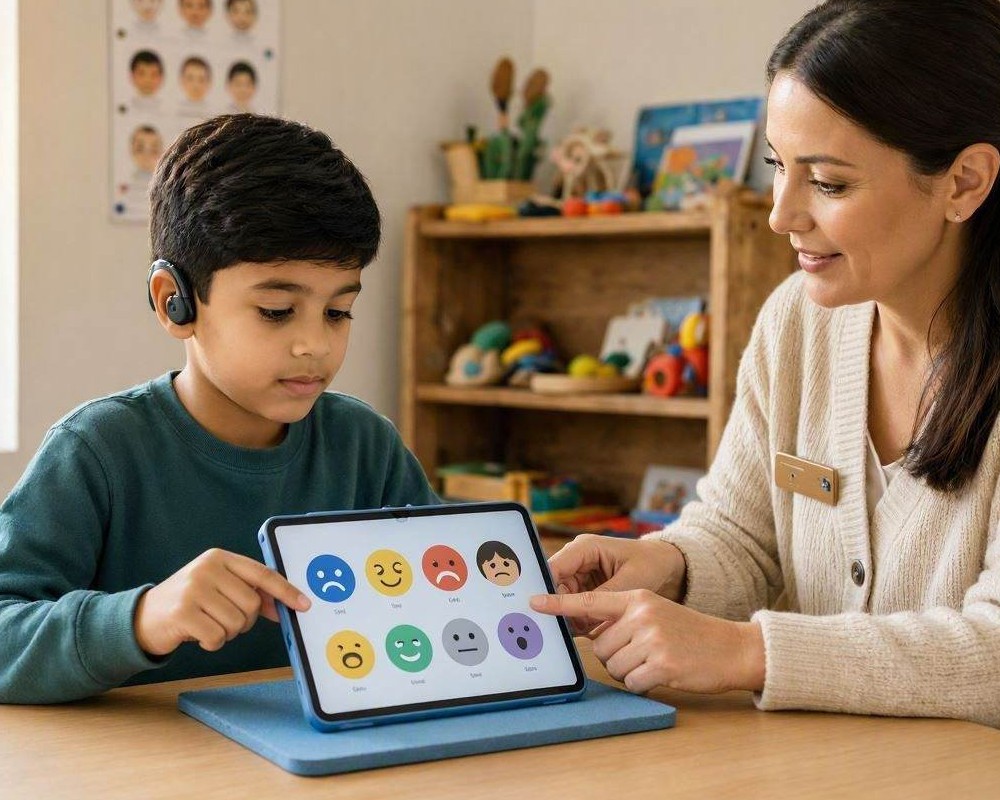
Understanding another person’s emotions can be challenging for some autistic children, particularly when facial expressions, voice, gestures, and context communicate different signals. An emotion recognition program can provide structured practice without the pressure of a fast-moving social situation. Through interactive exercises, children learn to notice relevant cues, compare possible interpretations, and respond in ways that support clearer communication.
Why Emotion Recognition Can Be Difficult
Emotions are rarely communicated through facial expressions alone. A conversation partner may smile while speaking nervously, use a neutral tone when disappointed, or look away because of distraction rather than disinterest. Interpreting these combinations requires attention to several channels at once.
Autistic children have diverse communication profiles. Some identify obvious expressions easily but find subtle or mixed emotions difficult. Others understand feelings in familiar people yet struggle with unfamiliar speakers. Sensory overload, anxiety, language processing demands, and cultural differences can also influence performance. For this reason, a useful program should teach flexible interpretation rather than suggest that every expression has one fixed meaning.
How the Program Works
Realistic Conversation Scenarios
The program presents short video clips, animated dialogues, or simulated conversations. After each scene, the child may choose what a speaker is likely feeling and identify the clues that support that answer. Scenarios can include excitement, frustration, uncertainty, embarrassment, boredom, and other emotions that commonly appear in daily interactions.
Multiple Communication Cues
Exercises direct attention to facial movement, vocal tone, posture, word choice, and conversational context. Instead of rewarding a guess based on one feature, the program encourages the child to combine information. It may also show that several interpretations are reasonable when evidence is incomplete.
Personalized Feedback and Progression
Immediate feedback explains why an answer may fit the situation. Difficulty can increase gradually, beginning with clear emotional signals and moving toward subtle, mixed, or ambiguous examples. A personalized system can repeat challenging skills while allowing children to advance in areas they already understand.

Potential Benefits for Children
Regular, supported practice may help children become more confident when interpreting conversations. Important potential benefits include:
- greater awareness of changes in tone, expression, and body language;
- improved understanding of how context affects emotional meaning;
- more confidence asking for clarification when signals are unclear;
- better preparation for classroom, family, and peer interactions;
- reduced anxiety through predictable, repeatable learning activities.
Success should not be measured only by correct labels. A child who learns to say, “You seem upset—am I understanding you correctly?” is using a valuable communication strategy. Asking respectfully is often more reliable than assuming another person’s internal state.
The Role of Parents, Teachers, and Therapists
Connecting Practice With Everyday Life
Adults can reinforce learning by discussing emotions during natural activities, such as reading stories, watching age-appropriate videos, or reflecting on a recent conversation. Questions like “What clues did you notice?” are more helpful than demanding a single correct response. Practice should remain collaborative and low pressure.
Respecting Autistic Communication
Emotion training should support understanding, not require children to imitate neurotypical behavior or hide autistic traits. Eye contact, for example, should not be treated as proof of attention or empathy. Children must also be taught that their own communication preferences and boundaries deserve respect.
What Makes an Emotion Program Effective?
A high-quality program is accessible, evidence-informed, customizable, and designed with input from autistic people. It should represent different ages, cultures, voices, and communication styles. Privacy protections are essential if the software records speech, facial responses, or performance data.
Most importantly, digital training should complement rather than replace supportive human interaction. When used with guidance from families, educators, and qualified professionals, an emotion recognition program can give autistic children a safe environment for exploring social cues while preserving autonomy, individuality, and authentic communication.