In recent years, there has been a significant advancement in the field of Artificial Intelligence (AI) and Augmented Reality (AR). These technologies have become increasingly popular and have the potential to enhance virtual experiences in various fields such as gaming, education, healthcare, and...
How Neural Networks Sort Medical Scans by Urgency for Doctors
2
09.11.2026
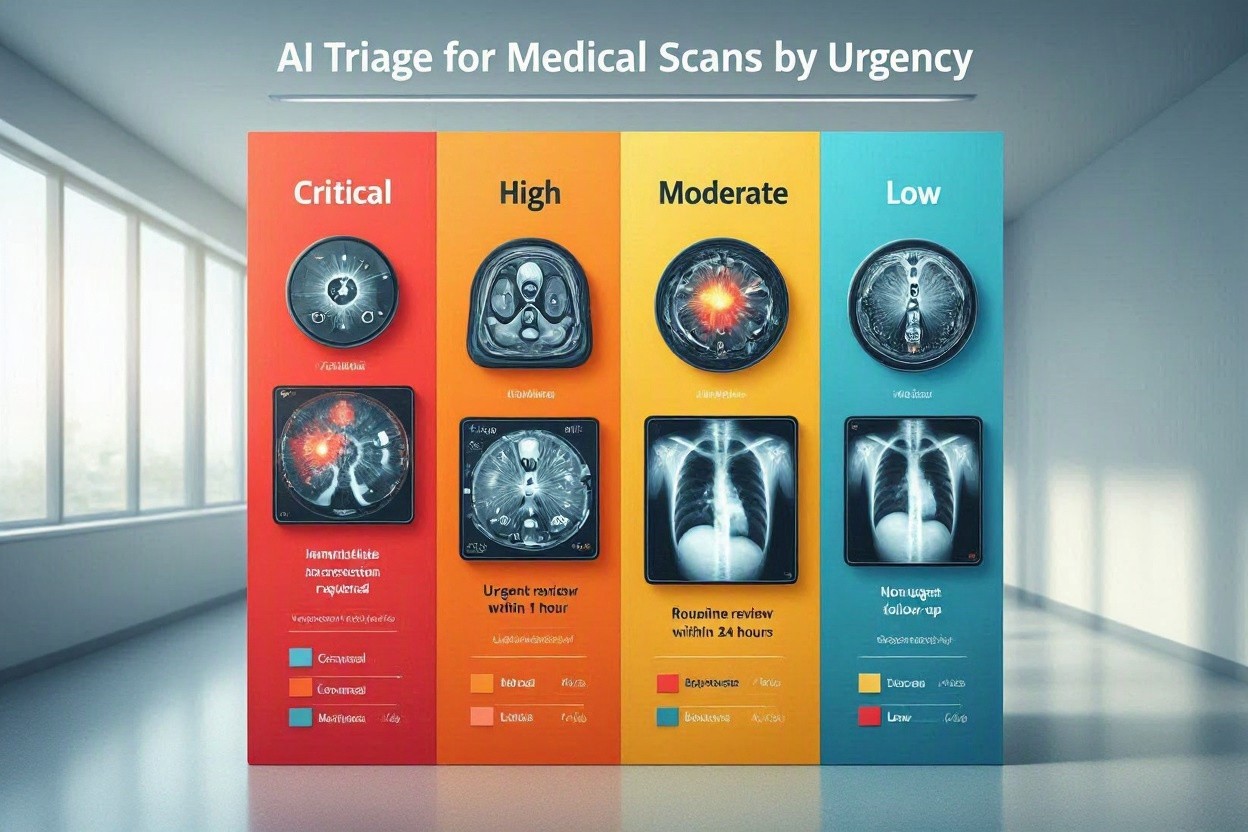
Radiology departments receive a constant flow of CT, MRI, X-ray, and ultrasound studies. Some scans show routine findings, while others contain signs of stroke, internal bleeding, pulmonary embolism, or traumatic injury that may require immediate action. A neural network designed for medical scan triage helps organize this workload by estimating urgency and bringing potentially critical cases to the doctor’s attention faster.
This technology does not replace radiologists or clinicians. Instead, it functions as a prioritization layer within the clinical workflow. Its main value is time: when minutes can affect survival or long-term recovery, earlier review of the right image can make a meaningful difference.
What Medical Scan Triage Means
Medical scan triage is the process of ranking imaging studies according to the likelihood that they contain urgent findings. Traditionally, scans are often reviewed in the order they arrive, with exceptions for cases manually marked as emergency. However, real-world queues are complex. A scan may be labeled routine even when it contains an unexpected dangerous abnormality.
A neural network can analyze incoming images automatically and assign an urgency score. Cases with higher scores are moved upward in the reading list, allowing the doctor to inspect them sooner. The final interpretation, diagnosis, and treatment decision remain fully human responsibilities.
Common Conditions Flagged by AI
Different systems are trained for different clinical tasks. In emergency and hospital settings, algorithms are often built to detect conditions where delayed diagnosis can be harmful.
- Intracranial hemorrhage on head CT scans
- Large vessel occlusion associated with acute stroke
- Pneumothorax on chest X-rays
- Pulmonary embolism on CT angiography
- Fractures after trauma
- Signs of aortic dissection or internal bleeding
How the Neural Network Works
Most medical imaging triage systems use deep learning, especially convolutional neural networks or transformer-based architectures. During development, the model is trained on large collections of scans labeled by qualified experts. These labels teach the system to recognize visual patterns associated with urgent pathology.
When a new scan enters the hospital imaging system, the neural network evaluates it in the background. It may examine slices of a CT scan, compare anatomical structures, identify abnormal densities, or highlight regions that influenced its prediction. The output is usually not a complete report, but a probability score, alert, or priority category.
From Image to Priority Queue
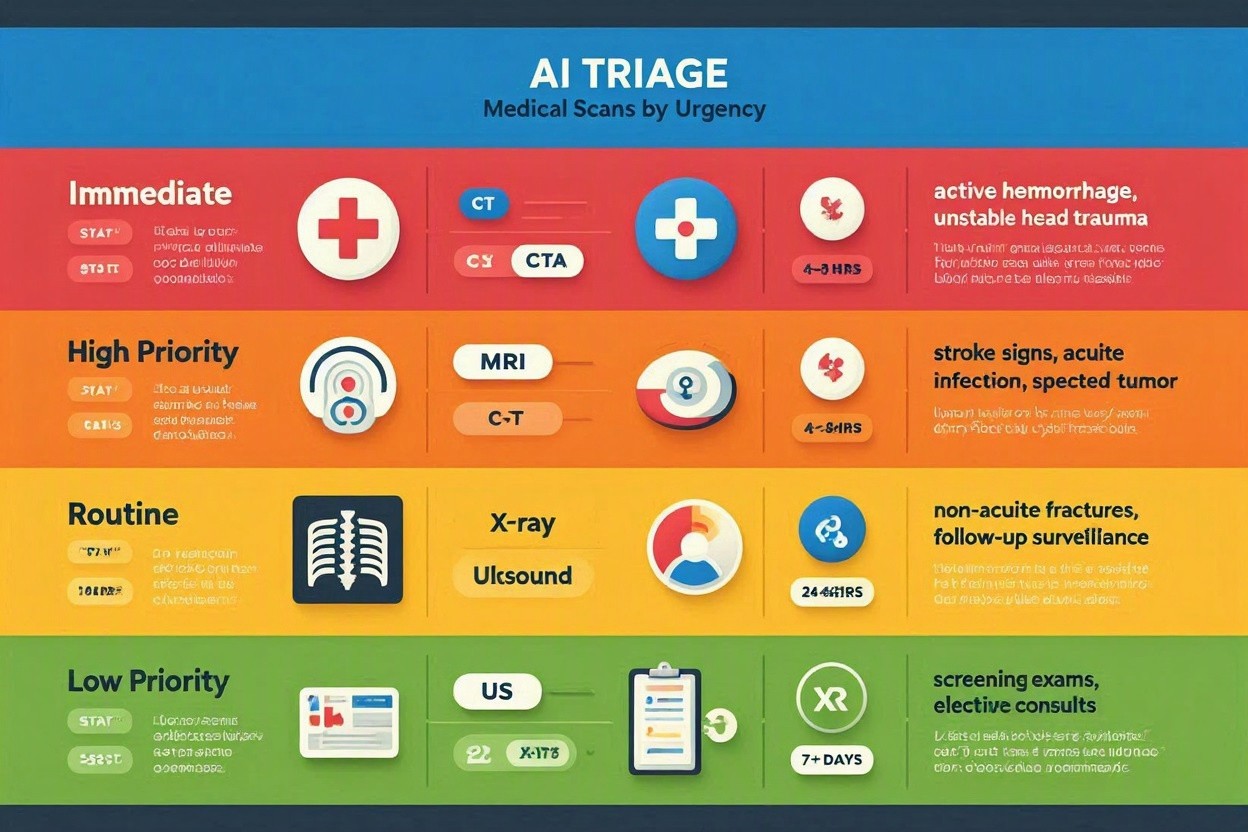
The workflow typically includes several steps. First, the scan is acquired and sent to the picture archiving and communication system. Next, the AI engine processes the images. If the model detects a high-risk pattern, it sends a notification or changes the case position in the radiologist’s worklist. The radiologist then reviews the scan, confirms or rejects the finding, and issues the official report.
This approach is most effective when it is integrated smoothly into existing systems. If alerts are too frequent, poorly explained, or disconnected from daily practice, clinicians may ignore them. Successful implementation depends on both technical accuracy and thoughtful workflow design.
Benefits for Doctors and Patients
The strongest benefit of neural network triage is faster attention to critical cases. In busy departments, urgent scans can be buried among many routine examinations. AI-based sorting reduces the risk that an important case waits unnoticed.
- Shorter time to review: High-risk studies can reach the top of the queue more quickly.
- Support during peak workload: AI can help maintain consistency when scan volume is high.
- Additional safety net: The system may flag unexpected abnormalities in studies not initially marked urgent.
- Better resource allocation: Teams can focus attention where clinical risk appears greatest.
For patients, the result may be earlier diagnosis, faster treatment, and reduced uncertainty. For doctors, the system can reduce cognitive burden by helping them navigate a demanding and time-sensitive caseload.
Limitations and Clinical Responsibility
Neural networks are powerful, but they are not infallible. They can miss subtle findings, over-prioritize harmless abnormalities, or perform less accurately on images from unfamiliar scanners, populations, or protocols. A model trained in one hospital may not behave identically in another.
Why Human Oversight Is Essential
Doctors understand the full clinical context: symptoms, laboratory results, prior imaging, medical history, and treatment risks. A neural network sees image data and patterns, but it does not truly understand the patient. Therefore, AI triage should be treated as decision support, not autonomous diagnosis.
Hospitals also need clear governance. Performance should be monitored after deployment, false positives and false negatives should be reviewed, and staff should understand what the system can and cannot do. Ethical use requires transparency, data protection, and careful management of bias.
The Future of AI-Based Imaging Triage
As medical datasets grow and algorithms improve, neural networks will become more capable of handling multiple conditions across different imaging modalities. Future systems may combine imaging findings with electronic health record data to produce more precise urgency estimates. They may also help coordinate care by alerting stroke teams, trauma units, or surgical specialists when critical patterns are detected.
The goal is not to create a faster machine for its own sake. The goal is to make clinical attention more responsive to patient risk. When implemented responsibly, a neural network that sorts medical scans by urgency can become a practical tool for safer radiology, more efficient hospitals, and better emergency care.