
In recent years, there has been a significant advancement in the field of Artificial Intelligence (AI) and Augmented Reality (AR). These technologies have become increasingly popular and have the potential to enhance virtual experiences in various fields such as gaming, education, healthcare, and...
Neural Network Speech Restoration for People After Larynx Removal
132
28.07.2026
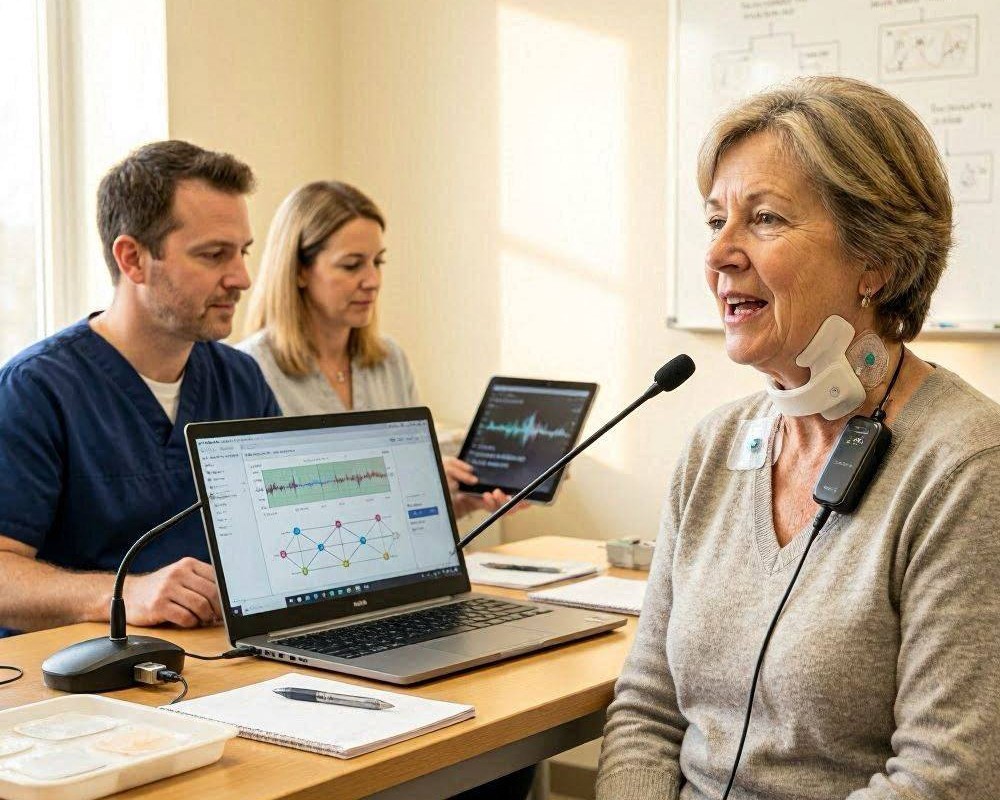
Losing the larynx is life-changing. For many people, voice is not only communication but also identity, confidence, and professional independence. Traditionally, speech rehabilitation after laryngectomy relies on surgical options, airway management, and training. Today, advances in machine learning add a new dimension: neural networks can help restore or reconstruct speech using data-driven signal processing.
This article explains how neural networks contribute to speech restoration after larynx removal, what inputs they use, how systems are trained, and what practical considerations matter for real-world adoption.
Why Larynx Removal Disrupts Speech
The larynx plays a central role in phonation by generating sound through vocal fold vibration. After laryngectomy, the conventional pathway is interrupted. Patients may still be able to breathe through a new route, but producing speech requires alternative mechanisms to generate and shape sound. Even when a patient can produce airflow-related signals, achieving intelligible, natural-sounding speech is difficult without specialized rehabilitation.
Neural network approaches aim to reduce the gap between available biological or device signals and the acoustic features of speech listeners recognize.
How Neural Networks Reconstruct Speech
Most neural speech restoration systems learn a mapping from an available input signal to speech output features. Depending on the scenario, the input may come from:
- Residual voice or airway signals captured through microphones and sensors
- Electroglottography-like proxies or other physiologic measurements
- Recorded speech patterns from the same patient prior to surgery (when available)
- Conditioning information such as language model context or prosody cues
In practice, systems may generate spectrograms (time–frequency representations), then convert them back into audio using neural vocoders. The core benefit is that a neural model can learn complex, non-linear relationships between the patient’s signal characteristics and intelligible speech.
Typical Model Components
While exact architectures differ, many pipelines include the following elements:
- Feature encoder: transforms input signals into a representation the model can process
- Acoustic mapper: predicts speech features such as mel-spectrograms or phoneme-like units
- Neural vocoder: synthesizes audio waveform from predicted features
- Post-processing: improves stability, reduces artifacts, and normalizes loudness
When patient-specific data is used, the system can better preserve individual vocal identity, even if the sound source is different after surgery.
Training Data: From Pre-Op Recordings to Simulation
High-quality training data is the difference between a promising prototype and a clinically useful tool. Ideally, a patient’s pre-laryngectomy recordings are used to train or fine-tune a model. However, collecting sufficient data before surgery is not always feasible.
Strategies to Overcome Limited Data
Researchers and clinicians often combine multiple approaches:
- Transfer learning: start from a model trained on large speech datasets, then adapt to the individual.
- Data augmentation: apply realistic perturbations (noise, channel effects, time stretching) to improve robustness.
- Cross-modal conditioning: leverage stable signals (e.g., airflow-related measurements) to guide generation.
- Semi-supervised learning: use a mix of labeled speech and unlabeled recordings to refine models.
These methods help the system generalize to the variability that naturally occurs in rehabilitation sessions—fatigue, medication changes, and differences in breathing patterns.
Clinical Workflow: From Recording to Real-Time Use
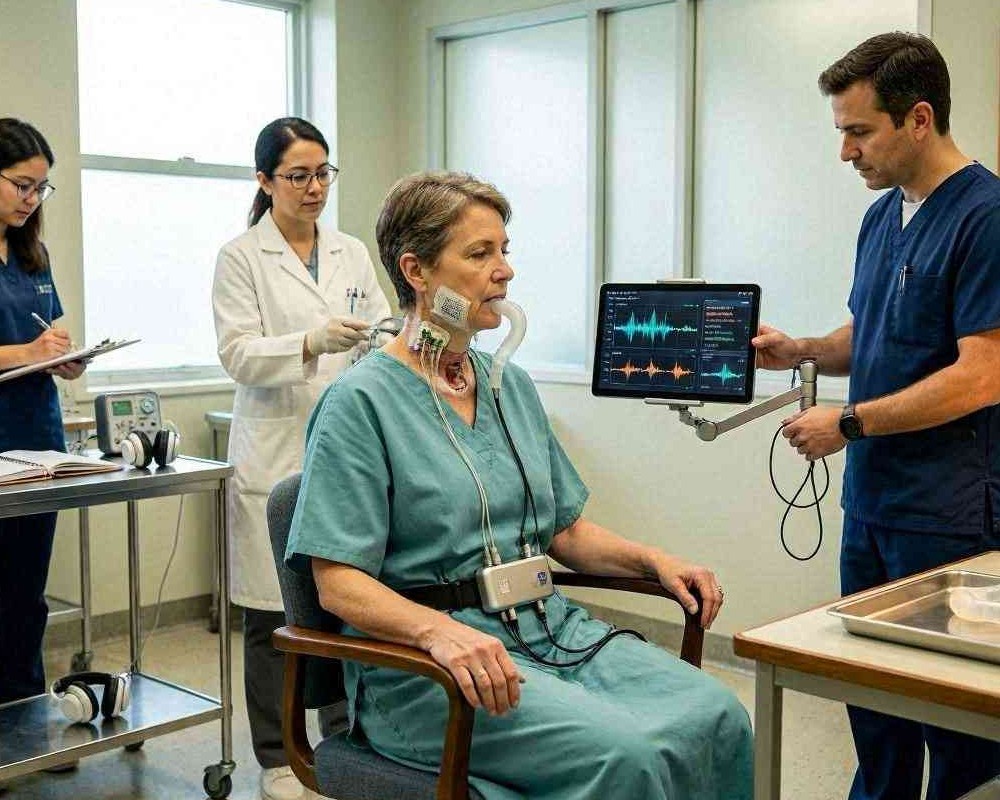
A practical speech restoration system must fit clinical reality. Most deployments follow a staged workflow:
- Assessment: baseline evaluation of intelligibility, comfort, and signal quality
- Calibration: align sensors, microphone placement, and sampling settings
- Model adaptation: fine-tune on patient data, then verify stability
- Therapist-guided practice: train articulation while the model improves output
- Monitoring: track progress over days and weeks, not just minutes
Neural systems can accelerate training by producing more reliable preliminary speech, allowing patients to focus on articulation and communication goals rather than starting from scratch.
Benefits, Limits, and Safety Considerations
The potential impact is significant: improved intelligibility, reduced cognitive load during communication, and a more natural voice experience. Yet there are limits.
Benefits:
- Better speech reconstruction under noisy conditions compared to purely rule-based methods
- Personalized output when adaptation is possible
- Faster rehabilitation feedback loops
Limitations:
- Performance depends on input signal quality and availability of patient-specific data
- Some voices may sound less natural if the model is not fully adapted
- Real-time systems require careful latency management to remain usable
Safety and ethics: Any speech reconstruction tool must respect medical oversight, protect sensitive recordings, and clarify that the system is an assistive technology—not a replacement for clinical care.
The Road Ahead
Neural networks are transforming speech restoration for people after larynx removal by learning to convert available biological or sensor signals into recognizable speech. As models improve in data efficiency, personalization, and robustness, the gap between “possible to speak” and “easy to communicate” can narrow significantly.
For patients and clinicians, the most meaningful progress will come from systems that integrate smoothly into rehabilitation, demonstrate consistent improvements over time, and prioritize user comfort and trust.